
Introduction
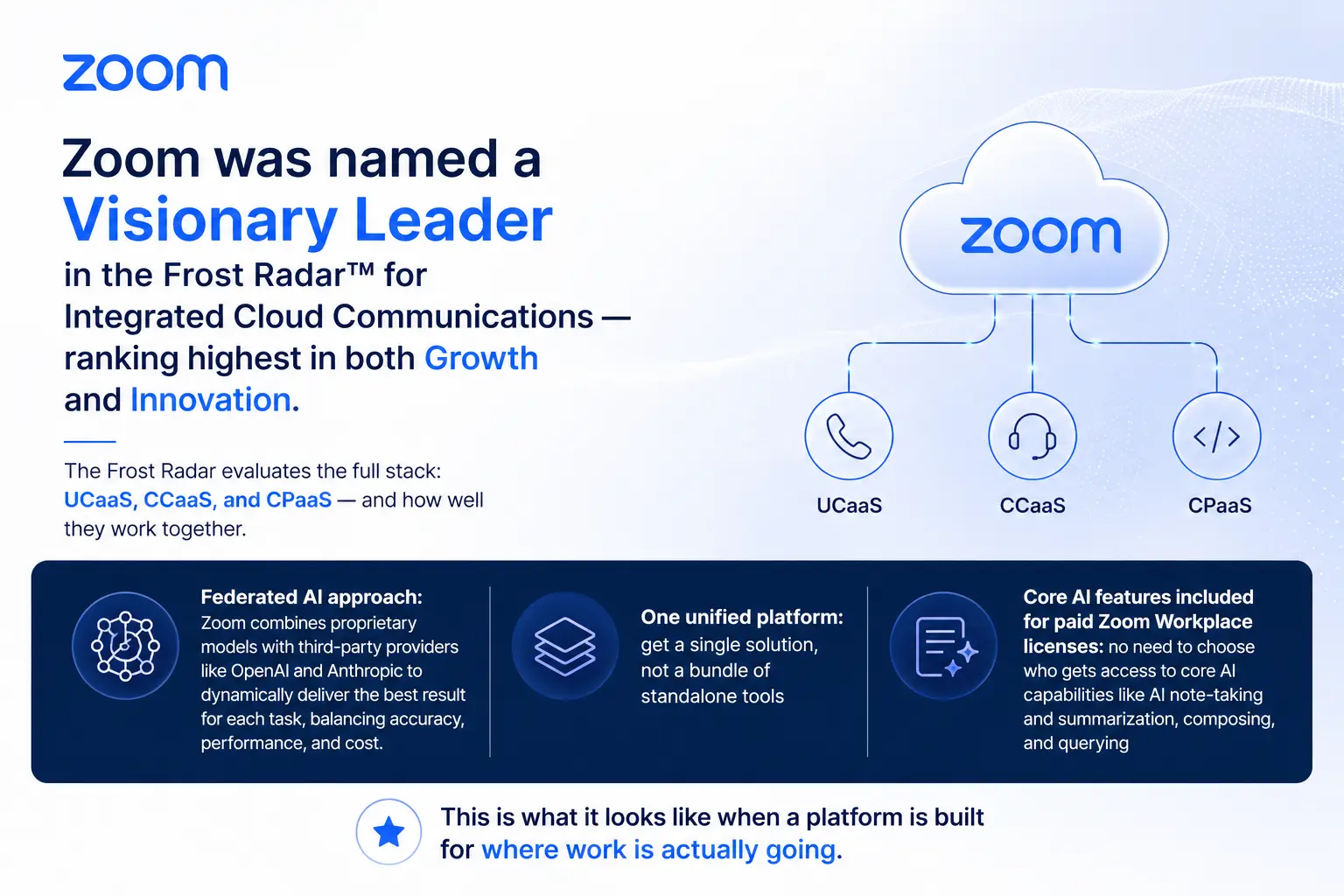
Integrated cloud communication platforms are transforming how businesses collaborate. In Frost & Sullivan’s 2026 Frost Radar: Integrated Cloud Communications Platforms report, Zoom was named a Visionary Leader, ranking highest of all vendors on both the Growth and Innovation indices. This means Frost & Sullivan found Zoom’s unified communications approach not only highly innovative but also rapidly expanding in market reach. The analysis evaluates the entire communications stack – from UCaaS (calls, meetings, chat) and CCaaS (contact center and customer experience) to CPaaS (programmable communication APIs) – and scores how well providers integrate these layers. In this article, we dive into what makes Zoom’s platform stand out, analyze the Frost Radar data, and explain industry trends driving the convergence of voice, video, messaging, and AI-driven workflows.
What is the Frost Radar?
Frost & Sullivan’s Frost Radar™ is a benchmarking framework that plots companies on two axes: a Growth Index (market expansion, adjacency capture, ecosystem scale) and an Innovation Index (feature depth, technology leadership). Vendors are then categorized into four quadrants: Visionary Leaders (high growth, high innovation), Growth Champions (high growth, moderate innovation), Innovators (high innovation, moderate growth), and Contenders (lower on both axes). Importantly, Frost explicitly measures not just standalone UCaaS or CCaaS products, but integrated cloud communications platforms. This means a vendor’s strength in voice calling, video conferencing, team chat, contact center, APIs, and AI features is assessed both individually and on how well those elements work together.
The Frost Radar framework aligns with the market trend that organizations no longer want siloed tools. The key question for buyers is not “Who has the best video service?” but “Who can deliver a unified communications experience – across employee collaboration and customer engagement – on one platform?”. The Radar report notes that as core UCaaS and CCaaS markets mature, companies must expand through adjacent offerings (analytics, employee experience, workforce management, etc.) and embed programmability. AI is treated as a cross-cutting enabler (or risk if ignored) rather than a separate category. The report also highlights the rise of "agentic AI" – AI that automates tasks and workflows – as a strategic imperative, reshaping how communication tools turn conversations into completed work.
Frost Radar 2026: Zoom’s Market Positioning
Figure: Frost & Sullivan’s 2026 Integrated Cloud Communications Frost Radar. Quadrants classify vendors by Growth Index (vertical axis) and Innovation Index (horizontal). Zoom appears at the top-right (Visionary Leaders) above all competitors.
The Frost Radar chart above (Figure) illustrates Zoom’s industry-leading position. Zoom sits at the extreme top-right corner, indicating it has the highest growth and innovation scores of all the evaluated providers. In the Visionary Leaders quadrant, Zoom is joined by Microsoft, Cisco, and RingCentral, but all three are slightly lower – showing that while they are strong, they trail Zoom in at least one dimension. For example, Zoom surpasses Microsoft in innovation (thanks to AI-first features) and surpasses Cisco and RingCentral in growth momentum.
On the left side (Growth Champions), Crexendo stands out as a smaller vendor experiencing rapid growth, though with more modest innovation. Meanwhile, the bottom-right Innovators quadrant is populated by companies like Intermedia, Dstny, Dialpad, GoTo, 8×8, Wildix, Vonage, Telavox, and Sangoma. These providers have strong innovation (they are adding new capabilities) but slower growth rates, perhaps due to narrower market presence. The bottom-left Contenders quadrant includes net2phone and NFON, reflecting lower growth and innovation relative to leaders. (Players like Alianza, Ooma, and Enreach are near the horizontal centerline, indicating more balanced but middle-of-pack performance.)
This positioning confirms Zoom’s narrative: it offers a truly integrated communications platform that is both expanding quickly and rich in new features. Other top incumbents (Microsoft, Cisco, RingCentral) are also innovating (AI, cloud services, global scale) but in this Frost analysis, Zoom outpaces them. The chart also implies strategic implications: Zoom’s strength comes from combining UCaaS, CCaaS, and CPaaS in one offering, whereas some Innovators may excel in one area (like contact center technology) but lack the breadth to move into Visionary territory.
Zoom’s top placement also reflects market dynamics. Frost notes that as cloud communication markets mature, success depends on expanding into adjacent services (contact center, analytics, workforce mgmt, etc.) and seamless integration via APIs. Zoom’s strategy of a “common platform rather than disconnected products” appears to fit this requirement perfectly, earning it the highest combined score.
Why Zoom Leads: Key Differentiators
Zoom’s Visionary Leader status is driven by several clear differentiators highlighted in Frost & Sullivan’s analysis and Zoom’s own positioning:
Federated AI Approach
Zoom is pioneering a federated AI architecture to power communications and collaboration. Instead of relying on a single large language model (LLM) or AI provider, Zoom dynamically routes tasks to the most suitable model. For instance, it uses its own proprietary AI models alongside foundation models from partners like OpenAI (e.g. GPT-4) and Anthropic. An AI request (transcription, summary, email draft, etc.) goes through Zoom’s orchestration layer, which evaluates factors such as cost, latency, and performance and then selects the appropriate model. This hybrid strategy “dynamically deliver[s] the best result for each task, balancing accuracy, performance, and cost,” as Zoom describes it. The net result is flexible AI: Zoom can leverage the latest breakthroughs from third parties while maintaining control, redundancy, and tuning from its own models.
This federated model is a strategic advantage. It protects Zoom from being locked into one AI vendor and allows continuous innovation. It also aligns with enterprise requirements for security and data governance (some tasks can stay on-prem or on Zoom’s model if needed). In sum, Zoom’s federated AI layer turns meetings and messages into actionable outcomes, rather than leaving AI as a standalone gimmick.
One Unified Platform
Zoom’s model is “a single solution, not a bundle of standalone tools.” While many vendors grew by acquiring or bolting on different products, Zoom has built (or unified) its stack to ensure seamless integration. Zoom Workplace now spans meetings, phone, messaging, email, documents, and more, all under one pane of glass. Its “Workplace” suite also extends into contact center (Zoom Contact Center), virtual agents, and revenue tools – essentially combining UCaaS and CCaaS into a single fabric.
This contrasts with some competitors: for example, a vendor might offer UCaaS (video/voice) through one app, CCaaS through another, and then CPaaS APIs separately. Zoom’s approach means updates, security, and AI features can propagate across the platform without wrangling multiple point solutions. It also simplifies the user experience: employees switch between chat, video calls, phone calls, and email in one ecosystem, and AI can pull from all those contexts at once. The Frost Radar explicitly notes that Zoom’s leader status “underscores its ability to unify communications, collaboration, and AI-powered productivity under one platform”.
Inclusive AI Features
A striking advantage for Zoom is that its core AI features are included for all paid Workplace users. Zoom emphasizes that capabilities like AI note-taking, automatic meeting summarization, AI-powered composing (for email or chat), and natural language querying come bundled at no extra charge. In practice, this means organizations don’t have to license expensive add-ons to give employees AI tools – they are “removing a common barrier to adoption,” as Frost analyst Elka Popova notes.
By contrast, some competitors restrict AI features to top-tier plans or separate AI modules. Zoom’s inclusive model encourages broad usage and rapid ROI: from day one, any user on a paid tier can have AI assist them. This likely contributes to higher innovation scores (more users experimenting with AI) and growth (easier sales without complex tier decisions). It also speaks to user experience: employees no longer wonder “who gets the AI features.”
Interoperability and Hybrid Work
While Zoom’s own platform is unified, it recognizes that enterprises run mixed systems. Zoom supports interoperability through features like Direct Routing and Operator Connect for Microsoft Teams, allowing companies to adopt Zoom’s telephony, collaboration, and AI without throwing away existing Teams infrastructure. In essence, Zoom can be plugged in where needed (e.g. as a calling service behind Teams), smoothing migration and co-existence. This strategy helps explain Zoom’s growth momentum: it can capture new customers and also expand within enterprises that are not all-in on Zoom yet.
Frost & Sullivan highlights that the “modern worker needs AI that leverages their conversations to help them get more done”. Zoom’s position is built around that vision – an AI-enabled “system of action” where meetings turn into tasks automatically. This resonates with the broader trend of hybrid work, where collaboration tools must adapt to distributed teams.
Competitive Landscape: Who’s Who
Zoom’s Frost Radar results invite a closer look at competitors and why they occupy their quadrants:
- Microsoft (Visionary Leaders): Microsoft Teams dominates enterprise UCaaS through its huge Office 365 ecosystem. Its Growth Index is high due to enterprise sales power, and its Innovation Index is bolstered by AI investments (e.g. Microsoft Copilot, Viva Insights). However, some analysis suggests Teams’ contact center (Dynamics 365) is not as integrated, potentially limiting innovation scoring. Still, Microsoft remains a top competitor.
- Cisco (Visionary Leaders): Cisco Webex and its contact center solutions are strong in security and network integration. Cisco’s long history in enterprise tech gives it stability (growth index) and broad feature set (innovation). However, it has historically been slower in cloud-native features compared to cloud-born vendors, which may explain why it doesn’t top Zoom.
- RingCentral (Visionary Leaders): RingCentral offers cloud voice, collaboration, and contact center. Its all-in-one approach and global reach place it high on both axes, though Zoom’s rapid growth seems to outstrip RingCentral’s trajectory.
- 8×8 (Innovators): Known for unified communications, contact center, and analytics, 8×8 focuses heavily on innovation (AI enhancements) but faces stiff competition in growth.
- Vonage (Innovators): Vonage’s cloud services and API platform (formerly VON) are innovative, especially with recent focus on CX and messaging, but it has smaller enterprise penetration.
- Dialpad, Intermedia, Dstny, GoTo (Innovators): These players push new features (AI meeting notes, CRM integrations, etc.) but occupy niches. They innovate in UCaaS/CCaaS, boosting their innovation indices.
- Crexendo (Growth Champions): Crexendo is growing fast in cloud PBX services – giving it a high Growth index – but it’s a smaller vendor, so its Innovation index is lower than the big tech players.
- NFON, net2phone (Contenders): These generally focus on phone systems with slower innovation, positioning them in the lower-left quadrant.
In essence, Zoom’s competitors vary by strength: some have market scale (Microsoft, Cisco) but may integrate AI slower; others have rapid feature development (Dialpad, 8×8) but less penetration. Zoom’s unique combination of scale and innovation propels it to the top.
Industry Trends Shaping Cloud Communications
Zoom’s Frost Radar recognition doesn’t exist in a vacuum – it reflects broad trends across cloud communications:
- AI Everywhere: AI is now table stakes. As the Vonage UCaaS trends report notes, “AI-powered tools to mobile-first platforms” are redefining how teams connect. Frost calls this “agentic AI” in communications. Across the industry, features like automated transcription, sentiment analysis, predictive analytics, smart routing, and virtual agents are transforming call centers and meetings. Providers that deeply embed AI into the workflow (like Zoom is doing with its federated approach) stand out; those treating AI as a gimmick risk falling behind.
- Platform Convergence: The lines between UCaaS, CCaaS, and CPaaS are blurring. Customers increasingly want a single vendor for employee collaboration and customer engagement. This drives mergers and development of integrated suites. Frost explicitly benchmarks how well vendors “enable integration across these layers”. Zoom’s unified platform capitalizes on this by design, whereas many traditional PBX or contact-center vendors are scrambling to catch up with integrations or API ecosystems.
- Hybrid Work & Cloud-Native Demand: The rise of distributed workforces means companies prioritize cloud-first, mobile-optimized communication tools. Investments are shifting from on-premises PBX hardware to cloud services that support any device. Frost observes a “return-to-office trend spurring workplace modernization” that blends on-prem and cloud services. Zoom’s cross-device apps (desktop, mobile, web) and its move into in-office solutions (Zoom Rooms, digital signage) align with this pattern.
- Security & Compliance as Differentiators: As AI and cloud usage expand, vendors emphasize security and data governance. Zoom’s approach of mixing models allows sensitive tasks to remain on trusted compute (a compliance lever), while others may rely fully on public AI. Frost explicitly calls out that “security, compliance, transparency, and data sovereignty” become key differentiators in AI adoption. Vendors that can meet enterprise compliance needs will gain trust (a factor in both innovation and growth).
- Vertical & Adjacency Expansion: Growth increasingly comes from adding adjacent services. Frost identifies contact center, analytics, workforce management, and employee experience tools as new battlegrounds. Zoom’s expansion into Zoom Contact Center, Zoom Virtual Agent, and even a VR workspace (Zoom Huddles) reflect this. For example, having AI-driven contact center solutions can help existing Zoom customers engage with their customers in the same ecosystem, increasing share-of-wallet and thus growth.
- APIs and Customization: With CPaaS, companies embed communications into business processes. Zoom offers APIs/SDKs for chat, voice, and video (Zoom Developer Platform) so enterprises can build custom workflows. Providers with rich API toolkits can win embedded use cases (like customer support bots, automated alerts, etc.). This programmability is now foundational – and Zoom’s unified data model could give it an edge in creating seamless automations.
In sum, the market is favoring vendors that treat communications as a comprehensive, intelligent platform. Zoom’s all-in-one strategy and AI focus are aligned with these trends, which helps explain why Frost rated it highest in growth and innovation.
Zoom Workplace: A Unified Communications Ecosystem
Zoom’s product architecture underpins its market success. The Zoom Workplace suite merges core collaboration tools with AI capabilities:
- Meetings & Chat: High-definition video meetings, persistent messaging, team channels – integrated with Zoom’s AI Companion assistant (for summaries, notes, insights).
- Phone System: Cloud PBX with desk phone and softphone, now integrated with contact center capabilities. Zoom offers Direct Routing for Teams, showing flexibility in adoption.
- Email & Calendaring: With Zoom Mail and Calendar (recently added), users can manage emails and events in the same interface. AI-enhanced email composition is on the roadmap.
- Contact Center & CX: Zoom Contact Center is built into the platform. AI-driven agents and workflows can handle calls/chat, all logged into Zoom’s system, bridging internal comms and customer engagements.
- Virtual Agents: Built on Topchat technology, Zoom can power AI chatbots and voice assistants for common queries.
- Employee Experience: Zoom’s platform even extends to things like digital signage, visitor management, desk booking (see its broader “Zoom Workplace” modules). These may seem tangential, but in a true unified platform, they tie into presence and scheduling.
- AI Companion: Across all these, the Zoom AI Companion (the context-aware assistant) provides summarization, search, brainstorming help, and more. It’s accessible in meetings, emails, and docs.
By contrast, a typical organization might have 3–5 separate tools: one for calls, one for messaging, another for email, a contact center system, etc. Zoom’s philosophy is to collapse those into one ecosystem. This matters for both admins (one security/training regime) and end-users (consistent UI, cross-context memory). It also means data is centralized: meeting transcripts, call records, chat logs, and emails all live within Zoom’s cloud. This unified data lake enables powerful AI: for example, the AI Companion can tap into past chat history while summarizing a meeting transcript to answer user queries.
From a technology standpoint, Zoom employs a microservices and cloud-native backend that scales these services globally. Its engineers can roll out a new AI feature or a security patch across meetings, chat, and phone simultaneously – instead of syncing multiple codebases. This consolidation is a key reason Frost notes Zoom’s “deep portfolio breadth” combined with AI as a differentiator.Enterprise Implications: Productivity and ROI
What does Zoom’s Frost Radar leadership mean for businesses? In practical terms:
- Improved Collaboration Efficiency: Features like AI note-taking, summary generation, and automated follow-ups mean employees spend less time on admin. Meetings become outputs, not just discussions. Productivity gains can be measured in hours saved per week per employee. Frost’s analysis argues this is a shift from “talking about outcomes to actually delivering them”.
- Simplified IT Management: Having one platform cuts vendor sprawl. It reduces integration overhead (for example, single sign-on and single directory for chat, email, and calls). Licensing is easier since AI features are bundled. Zoom’s recognition as a unified platform means IT teams don’t have to cobble together disparate products.
- Faster AI Adoption: Because Zoom includes AI for all users, enterprises can implement AI-driven workflows quickly without negotiating extra budgets. Training is also simplified: employees learn one AI assistant (Zoom Companion) that works across tasks, rather than multiple vendor-specific assistants.
- Future-Proofing: The clear message from Frost is that AI-integrated, API-driven cloud platforms are the future. Companies investing in such platforms (like Zoom’s) are placing bets on long-term trends. For example, analytics and employee experience tools in Zoom will likely mature over time. This positions enterprises to stay competitive in a hybrid, AI-rich environment.
- Cross-Department Value: Integrated platforms can deliver value beyond IT. For instance, marketing teams running webinars on Zoom and customer service using Zoom Contact Center are still within the same ecosystem. Data flows more freely (e.g. post-webinar leads automatically enter CRM, support calls trigger follow-up emails). This cross-pollination is harder when systems are siloed.
However, it’s not just about one vendor. The Frost Radar encourages organizations to consider how vendors’ offerings fit their unique mix of UCaaS, CCaaS, and CPaaS needs. While Zoom leads overall, some businesses may still use Teams for internal collaboration or certain on-prem solutions. The interoperability aspect means Zoom can coexist with others as needed, which the Frost report highlights as important for adopting AI without disrupting workflows.
Visualizing the Data: Market Positioning Diagram
The above Market Positioning Diagram is a conceptual rendering (adapted from Frost Radar) showing Zoom’s peers by quadrant. Zoom is alone at the top-right as the standout Visionary Leader, while competitors occupy other quadrants based on their relative growth and innovation scores
Conclusion
Zoom’s recognition as a Visionary Leader in the 2026 Frost Radar™ for Integrated Cloud Communications underscores how its strategy aligns with emerging market realities. By uniting UCaaS, CCaaS, and CPaaS into one platform enhanced by a federated AI layer, Zoom meets the demand for intelligent, outcome-driven communications. The Frost Radar image makes clear: Zoom outpaces other tech giants in both innovation and growth. Its peers like Microsoft, Cisco, and RingCentral also lead but trail slightly, and many specialized providers lie in other quadrants.
For enterprises, this means Zoom offers a consolidated solution that can accelerate productivity (via built-in AI tools) while simplifying management. As AI, hybrid work, and integration become more crucial, platforms that embed intelligence across every layer will win. Zoom’s Frost ranking signals it is at the forefront of this trend.
Moving forward, organizations choosing a cloud communications platform should consider not just feature checklists, but how AI-automation, user experience, and extensibility are baked into the solution. Zoom’s success suggests that a single, AI-first platform is where unified communications is headed, enabling work to be completed as a system of action rather than isolated tasks.
Key Takeaways
- Zoom is Frost’s #1 in Growth & Innovation: The Frost Radar 2026 chart places Zoom at the very top-right, exceeding competitors on both axes.
- Unified Platform Advantage: Zoom Workplace integrates meetings, calls, chat, email, documents, and customer engagement (contact center) in one platform.
- Federated AI Strategy: Zoom combines its own AI models with OpenAI/Anthropic models, routing tasks optimally to balance performance, accuracy, and cost.
- Core AI Features Included: Paid Zoom plans include AI note-taking, summarization, drafting, and querying out of the box, lowering barriers to AI adoption.
- Industry Trends: The shift toward AI-driven, integrated communication platforms (UCaaS+CCaaS+CPaaS) favors vendors like Zoom that unify and automate workflows.