
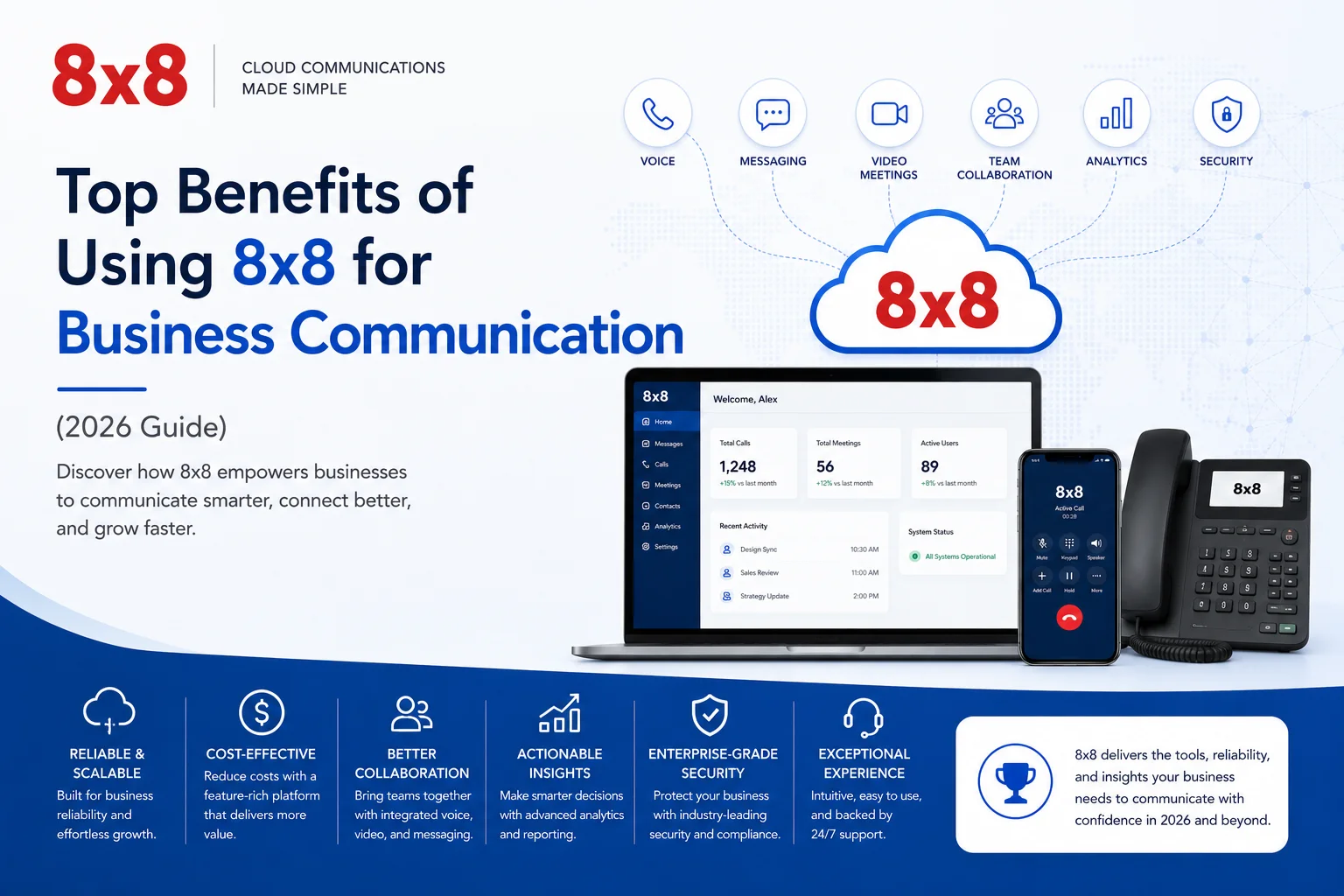
Top Benefits of Using 8x8 for Business Communication (2026 Guide)
Introduction
Every business communication platform promises to save you money, improve team collaboration, and make your customers happier. The marketing language is nearly identical across every vendor in the space.
What actually separates platforms isn't the feature list — it's whether those features translate into measurable operational improvements once they're deployed in a real business environment.
This guide focuses on the tangible business benefits 8x8 delivers: what changes in day-to-day operations, where the financial impact shows up, and which types of organizations tend to see the strongest returns. We'll also be direct about where the benefits are more modest, so you can make an informed decision rather than a hopeful one.
Why Businesses Switch to 8x8
The most common trigger for evaluating 8x8 isn't excitement about new technology — it's frustration with the status quo. Businesses typically reach out when they're dealing with one or more of these situations:
- Phone bills that don't reflect the volume of calls they're actually making
- A remote or hybrid team where the existing phone system only works reliably in the office
- A customer support operation where calls are being missed, wait times are climbing, or there's no visibility into what's happening
- Multiple communication tools — a phone system, a video platform, a team chat app — that don't integrate and create fragmented workflows
8x8 addresses all of these within a single platform. That consolidation is the starting point for most of the benefits below.
1. Replacing Multiple Tools with One Platform
The most immediate operational benefit 8x8 delivers is consolidation. The average business using a traditional phone system alongside a separate video conferencing subscription and a team messaging tool is managing three vendor relationships, three billing cycles, three sets of credentials, and three separate interfaces for their team to learn.
8x8 replaces all three with a single platform: voice calls, HD video meetings, team messaging, and file sharing all operate through the same 8x8 Work interface on desktop and mobile.
Where this shows up in practice:
- Reduced software spend (one subscription instead of three)
- Faster onboarding for new employees (one system to learn)
- Less context-switching for teams who move between calls, meetings, and messaging throughout the day
- Simplified IT administration — one admin console, one vendor to call when something breaks
The consolidation benefit is real but worth calibrating. If your team is deeply embedded in specific tools — if Slack is part of your culture, or Zoom meetings are habitual — the switch to 8x8's native equivalents requires change management. The platform integrates with both, so you don't have to abandon them, but the consolidation value is higher for businesses building their communication stack from scratch than for those replacing deeply entrenched tools.
2. Meaningful Cost Reduction
Cost savings from switching to VoIP from a traditional phone system are well-documented and consistent. The specific savings for any business depend on their current setup, but the sources of reduction are predictable:
Hardware elimination. Traditional PBX systems require physical on-site equipment with associated purchase costs, maintenance contracts, and eventual replacement. 8x8 runs entirely in the cloud — the only hardware cost is optional desk phones, and most teams use the softphone app on existing devices instead.
Per-line fee reduction. Traditional systems charge per physical line. 8x8 charges per user on a flat monthly subscription that includes unlimited domestic calling and, depending on the plan, unlimited calling to 14–48 countries. Businesses with meaningful international call volume often see the most dramatic reductions here.
Maintenance cost elimination. No on-site PBX means no maintenance contracts, no hardware repair bills, and no technician call-out fees.
Consolidation savings. Replacing separate video conferencing and messaging subscriptions with 8x8's included capabilities reduces overall software spend.
Realistic expectation: Small businesses replacing traditional phone systems typically report 30–50% reductions in total communication costs. The exact figure depends heavily on current spending patterns and how much international calling you do.
3. Remote and Hybrid Work Support That Actually Works
Location independence isn't a marketing claim with 8x8 — it's structural. The system routes calls to users, not to physical phone lines. An employee in a home office takes calls on the same business number as they would at their desk. A team spread across three cities shares the same call routing, the same directory, and the same admin console.
What this enables:
- Business continuity when offices are inaccessible
- Consistent professional experience for customers regardless of where your team is working
- Hiring without geographic constraint — a new team member anywhere with internet access can be fully operational on day one
- Unified directory and internal calling across all locations
The practical requirement: Remote VoIP call quality depends on the quality of the user's internet connection. A team member on an unstable home internet connection or a congested Wi-Fi network will have inconsistent call quality. This isn't a platform limitation so much as a VoIP reality — but it's worth acknowledging. The fix is straightforward (wired connections, QoS-enabled routers, adequate upload bandwidth), but it requires some attention during deployment.
4. Faster, More Consistent Customer Experience
For any business where customers reach you by phone, the configuration of your communication system directly affects how those interactions feel. Long wait times, calls routed to the wrong person, voicemails that go unanswered, or calls that ring out during business hours all erode customer trust in ways that don't always show up in direct feedback but do show up in retention rates.
8x8 gives you the tools to eliminate most of those friction points:
Smart call routing distributes calls based on rules you define — by department, by skill set, by time of day, or by caller history. When configured well, the right person gets the right call more often, which reduces transfers and repeat contacts.
Auto-attendant means no call goes unanswered during business hours without at least a professional greeting and clear direction. After-hours calls can route to voicemail, an emergency line, or an on-call team member — whatever fits your service model.
Queue management (on X4 and above) lets callers wait with an estimated hold time rather than hearing endless ringing. Callers who know they're in a queue and have a realistic wait time estimate have significantly higher patience than callers who don't know if anyone's coming.
Call analytics surface patterns that would otherwise be invisible — peak call times, abandonment rates, average handle time, first-call resolution rates. These metrics help you staff appropriately and identify the specific points in your call flow where customer experience is breaking down.
5. Built-In Analytics That Inform Decisions
Most businesses know calls are happening. Few businesses know which calls converted, how long customers waited before hanging up, which agents handle issues fastest, or whether after-hours calls are being missed at a rate that represents meaningful lost revenue.
8x8's analytics dashboard changes that. The reporting covers:
- Call volume and patterns — peak times, daily and weekly trends, seasonal variation
- Queue performance — wait times, abandonment rates, calls answered vs. missed
- Agent performance — call duration, handling time, call outcomes per agent
- Call quality metrics — technical data on latency, jitter, and packet loss that flags network issues before they become customer-facing problems
On higher-tier plans (X8), AI-powered speech analytics add transcription, sentiment scoring, and conversation intelligence that allow quality management teams to review interactions at scale — identifying coaching opportunities, compliance risks, and customer experience patterns without manually listening to recordings.
For businesses making decisions about staffing, routing, and service levels based on intuition rather than data, this visibility is genuinely transformative.
6. Scalability Without Infrastructure Changes
Adding a user to a traditional phone system requires hardware — potentially a new physical handset, a new line, or an expansion module for the PBX. Adding a user to 8x8 takes about five minutes in the Admin Console.
This difference matters most during growth phases, when hiring is happening quickly and communication infrastructure needs to keep pace without becoming a bottleneck.
What scaling on 8x8 actually involves:
- Create the user profile in the Admin Console
- Assign an extension and phone number
- Send the user their login credentials
- They download the 8x8 Work app and are operational
There's no hardware ordering lead time, no technician scheduling, and no configuration complexity that grows proportionally with headcount. Opening a new office location is similarly straightforward — users in the new location join the same system, same directory, and same routing infrastructure as everyone else.
The ceiling on this is high. 8x8's X6–X8 plans support large-scale contact center operations with hundreds of seats. Businesses that start on X2 with a small team can grow into enterprise contact center territory without migrating to a different platform.
7. Security and Compliance That Meets Enterprise Standards
Communication security is easy to overlook until something goes wrong. 8x8 addresses this at the infrastructure level rather than leaving it as an optional configuration:
- End-to-end encryption for voice and video calls
- TLS and SRTP protocols securing data in transit
- SOC 2 Type II certification — independently audited security controls
- GDPR compliance for businesses operating in or serving European markets
- HIPAA-compliant configurations available for healthcare businesses (requires specific plan and agreement)
- 99.999% uptime SLA — equivalent to less than six minutes of downtime per year
For most small and mid-sized businesses, these certifications matter primarily as a vendor qualification check. For businesses in regulated industries — healthcare, financial services, legal — they're prerequisite requirements for any communication platform under consideration.
8. CRM and Business Tool Integration
The value of a communication platform compounds when it connects with the tools your team already uses. 8x8 integrates with the platforms most businesses rely on:
What integration actually changes: When a customer calls, their CRM record surfaces automatically — no manual lookup required. Calls are logged to the CRM without the agent having to remember to add a note. Call recordings link to the relevant contact record. Activity history is complete and accurate.
For sales teams, this means less time on administrative tasks and better context going into every call. For support teams, it means faster resolution because agents have the customer's full history immediately available.
9. Global Calling Without Per-Minute Anxiety
For businesses with international clients, remote employees abroad, or offices in multiple countries, the cost and complexity of international calling on traditional systems is a recurring headache.
8x8's X2 plan includes unlimited calling to 14 countries. The X4 plan extends that to 48 countries. Teams making frequent international calls stop tracking per-minute rates and start treating international calls the same way they treat domestic ones — as part of normal business communication.
Beyond cost, 8x8 supports local number provisioning in multiple countries, which means your business can maintain local-number presence in markets you serve regularly without establishing a physical office there.
Who Gets the Most Out of 8x8
The benefits above scale with how intensively you use the platform. Businesses that see the strongest returns share some common characteristics:
- Customer-facing operations — sales teams, support centers, or service businesses where phone communication is central to revenue and retention
- Remote or distributed teams where location-independent connectivity is a daily operational requirement
- Growing businesses that need communication infrastructure that scales with them rather than requiring a platform change at some headcount threshold
- International operations — businesses with overseas clients, employees, or offices where international calling volume is significant
- Data-driven management — teams where performance analytics inform staffing, routing, and coaching decisions
Conversely, the value proposition is weaker for very small businesses with purely domestic, low-volume calling needs. The platform's depth exceeds what they'll use, and simpler alternatives cost less.