What is RingCentral? A complete guide to the enterprise UCaaS platform (2026)
Business communication stacks have multiplied into an expensive, disconnected mess — a separate VoIP carrier, a video conferencing tool, a team messaging app, a contact center platform, and an AI transcription bolt-on. RingCentral's case is simple: all of that should be one thing. Whether that pitch matches your organization's reality is what this guide helps you evaluate.
What is RingCentral?
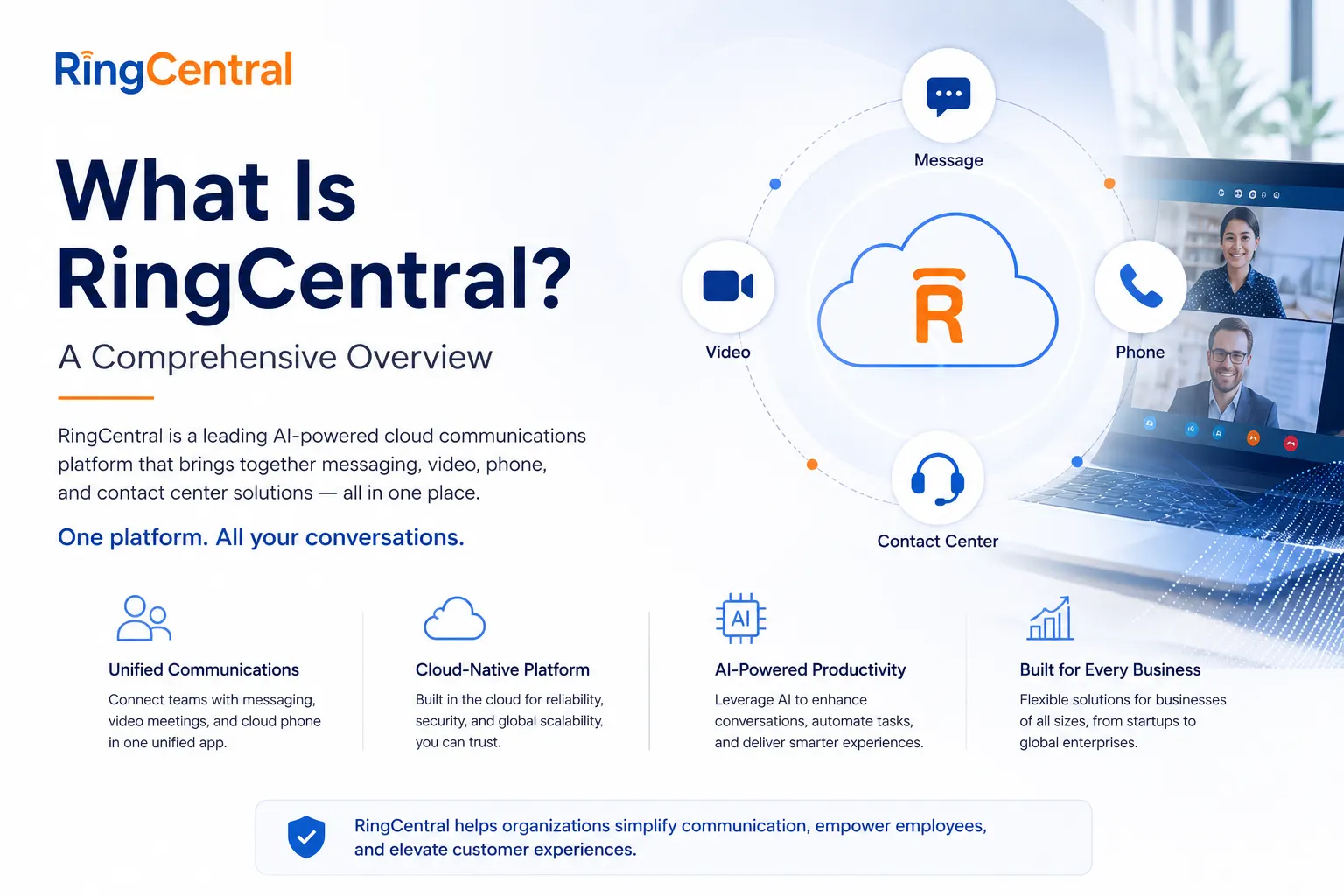
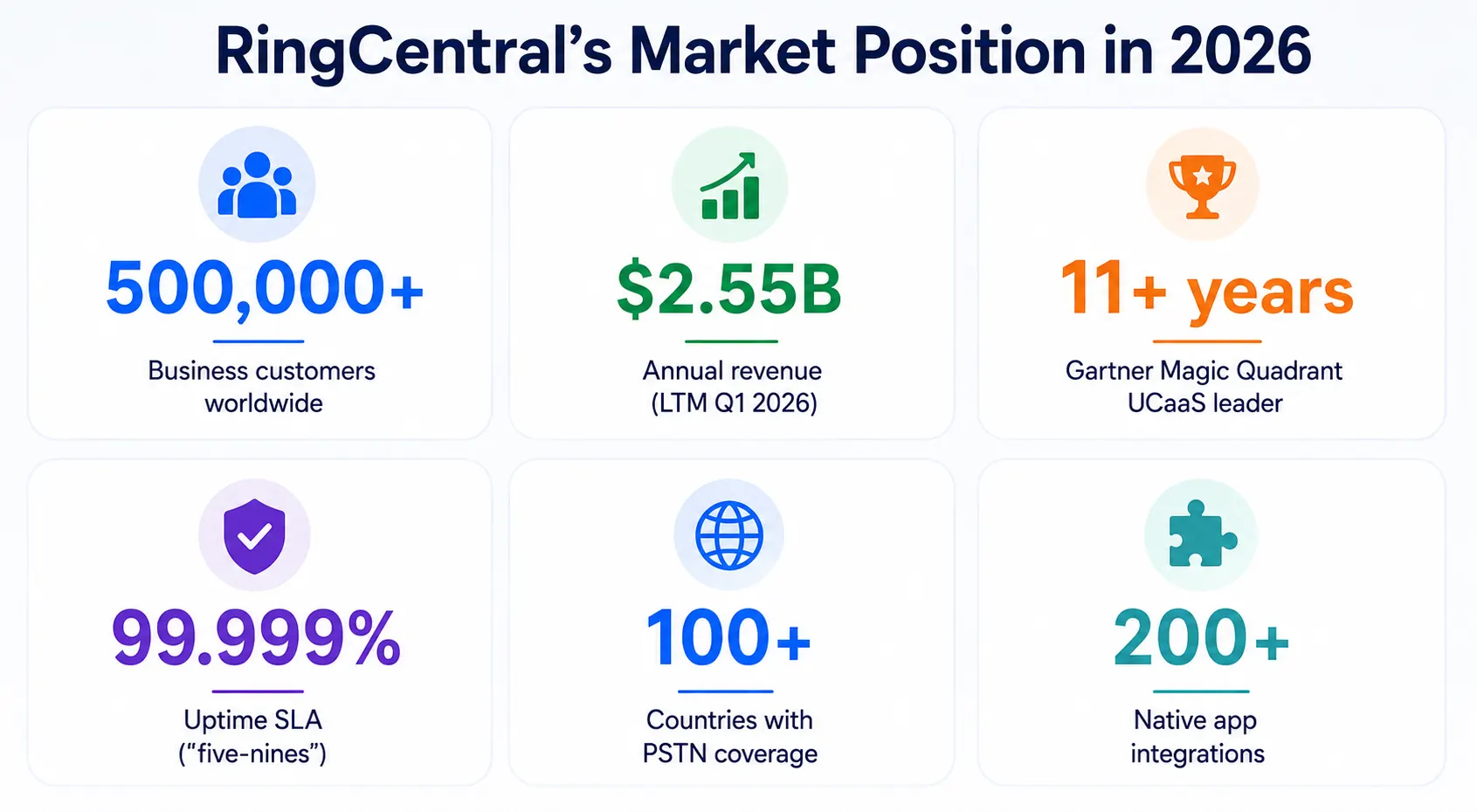
RingCentral is a cloud-based enterprise UCaaS (Unified Communications as a Service) platform that combines business VoIP calling, video meetings, team messaging, SMS, fax, and contact center capabilities into a single subscription. The core product is called RingEX. Founded in 1999 and serving 500,000+ businesses globally, RingCentral has held a Gartner Magic Quadrant leadership position in UCaaS for over a decade and guarantees 99.999% uptime. In 2026, the company describes itself as "a global leader in agentic voice AI–powered business communications."
The practical definition: RingCentral replaces your on-premises PBX phone system, your separate video conferencing subscription, and your standalone team messaging tool with one cloud-hosted platform. Employees access it through a single app on desktop, mobile, or a VoIP desk phone. Everything — call logs, voicemail transcripts, meeting recordings, chat history — syncs across devices in real time.
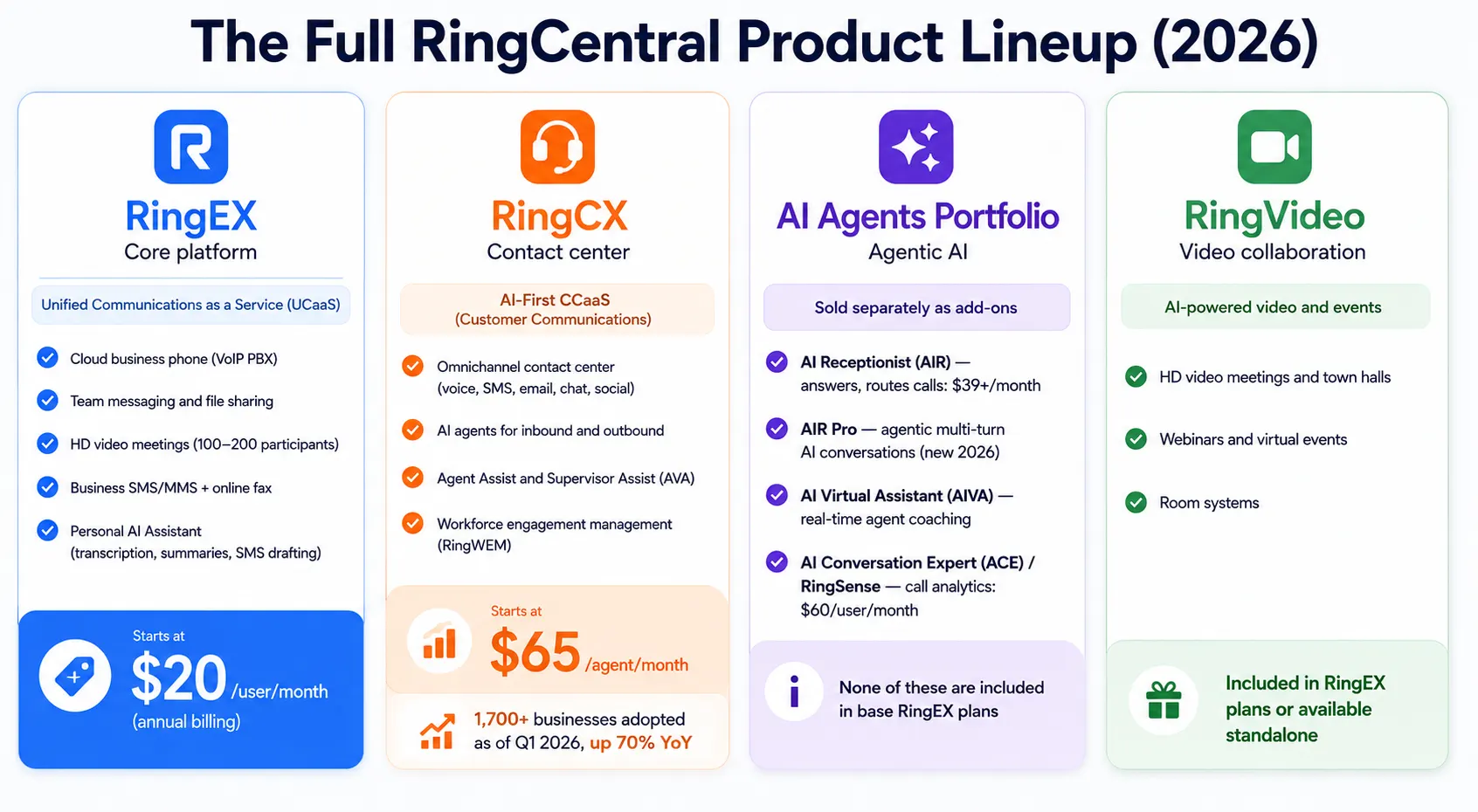
What separates RingCentral from simpler VoIP providers is breadth. The platform spans employee-facing unified communications (RingEX), customer-facing contact center (RingCX), AI-powered call automation (AIR Pro), video collaboration (RingVideo), and a developer API layer — all under one vendor and one bill. By 2026, the company's revenue has reached $2.55 billion, reflecting its position as one of the largest cloud communications vendors in the world.
 In the G2 Summer 2026 reports, RingEX was featured in 592 reports and ranked #1 in fifteen categories, with a total G2 score of 4.2 out of 5. RingCentral's own research of 2,000 IT, HR, and CX decision-makers found that 97% of organizations are already using AI in some form, and 96% say AI agents will be essential to competitiveness — positioning RingCentral's AI investments at the center of where enterprise buyers are heading.
The full RingCentral product lineup (2026)
Understanding RingCentral means understanding that it's several distinct products under one brand. Pricing and features vary significantly between them.
Core RingEX features in detail
Cloud phone system (VoIP PBX)
RingEX's phone system replaces on-premises PBX hardware with a cloud-hosted equivalent. Every user gets a business phone number, voicemail-to-email transcription, visual voicemail, and access to enterprise call management features: auto-attendants (IVR menus), call queues, hunt groups, call forwarding, call flip (seamlessly move a call from desk to mobile), call recording, and multi-level routing. Virtual phone numbers are available in 100+ countries. No on-site hardware or phone carrier contracts are required — all calls traverse RingCentral's VoIP network over your internet connection.
Team messaging and collaboration
Persistent team chat is built into the same RingEX app as the phone system. Users create team channels and direct messages, share files, assign tasks, and search all message history. Files from Google Drive, Dropbox, Box, and OneDrive can be attached directly. The 2026 update added shared team inboxes, the ability to send personalized SMS campaigns, request quick payments, and automate messages — expanding messaging beyond internal chat into customer-facing communication from the same interface.
HD video meetings
RingEX includes video conferencing with up to 100 participants on Core and Advanced plans, and 200 on Ultra. Features include screen sharing, virtual whiteboards, meeting recording, background blur, and live captions. The Personal AI Assistant automates real-time call transcriptions, generates accurate action items, and crafts contextual SMS responses. Meetings are backed by RingCentral's globally distributed infrastructure, with the same 99.999% uptime SLA as the phone system.
Business SMS, MMS, and online fax
Users send and receive SMS/MMS from their business number, with all messages logged in the RingEX platform. RingCentral has expanded international SMS to 190 countries with alphanumeric sender IDs and an average deliverability rate of 98%. Online fax (eFax) lets users send and receive faxes via the app or email — no fax hardware required. Note: SMS is capped at 25 messages/user/month on Core; 100 on Advanced. Heavy SMS users should budget for the Advanced plan or SMS boosters.
Integrations (200+ apps)
RingCentral integrates natively with Salesforce (Advanced/Ultra only), HubSpot, Microsoft 365, Google Workspace, Zendesk, ServiceNow, Slack, and 200+ other business apps. CRM integrations enable click-to-dial from within Salesforce leads, automatic call logging, and screen-pop (customer details surface on incoming calls). A REST API and developer platform support custom integrations for organizations with unique workflow requirements.
Security and compliance
All RingCentral communications are encrypted. The platform maintains SOC 2, HIPAA/HITRUST, PCI DSS, GDPR, and FedRAMP certifications. Healthcare and financial services organizations can sign a Business Associate Agreement (BAA) for HIPAA compliance — this requires an industry-specific plan, not publicly priced. HIPAA features are integrated into the plan rather than sold as add-ons.
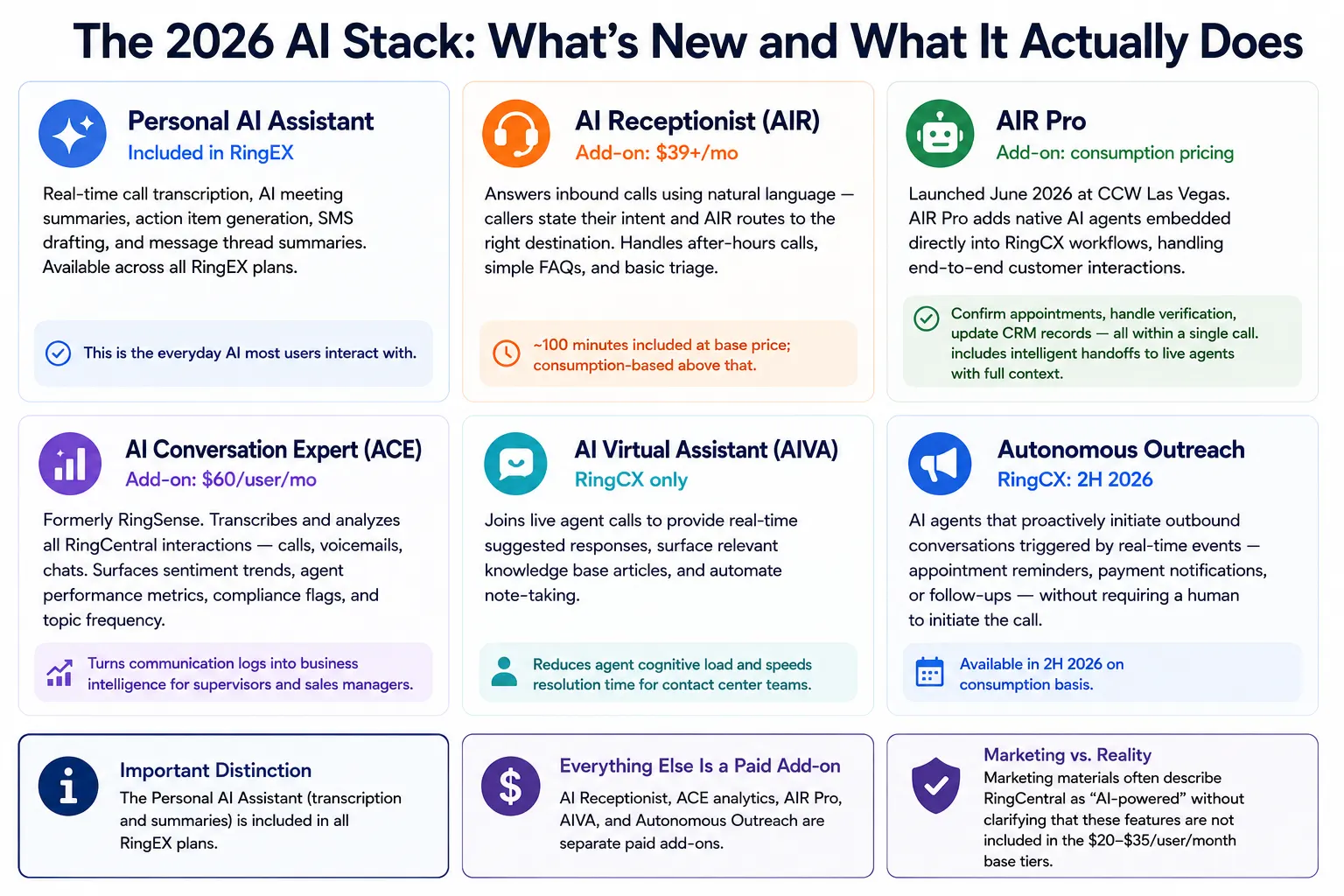
The 2026 AI stack: what's new and what it actually does
AI is the most significant development in RingCentral's 2026 positioning. The company now describes itself as an "agentic voice AI" platform — a shift from describing AI as a feature to describing it as the product's core identity. Here's what the AI portfolio actually includes:
How the cloud delivery model works
Traditional PBX systems require on-site servers connected to dedicated phone lines. Adding users means installing hardware. Moving offices means reconfiguring everything. Downtime is a local IT problem.
RingCentral's cloud model replaces all of that with a vendor-hosted infrastructure your team accesses through software. Here's the practical difference:
- No hardware required: Users install the RingEX app on their existing devices. IT provisions users through a web admin console, not a server room.
- Device flexibility: A single business number rings simultaneously on a desk phone, desktop app, and mobile app. Call flip lets users move active calls between devices without the other party noticing.
- Automatic updates: New features (like the 2026 shared SMS inbox or AI summaries) roll out automatically. No upgrade cycles, no version compatibility issues.
- Global scale: Adding users in a new country means allocating a local number in the admin portal — not installing new phone infrastructure in that office.
- Desk phone support: Teams that want physical handsets can use SIP-compatible IP phones from Yealink, Poly, or Cisco. RingCentral supports plug-and-play provisioning through the same cloud admin portal.
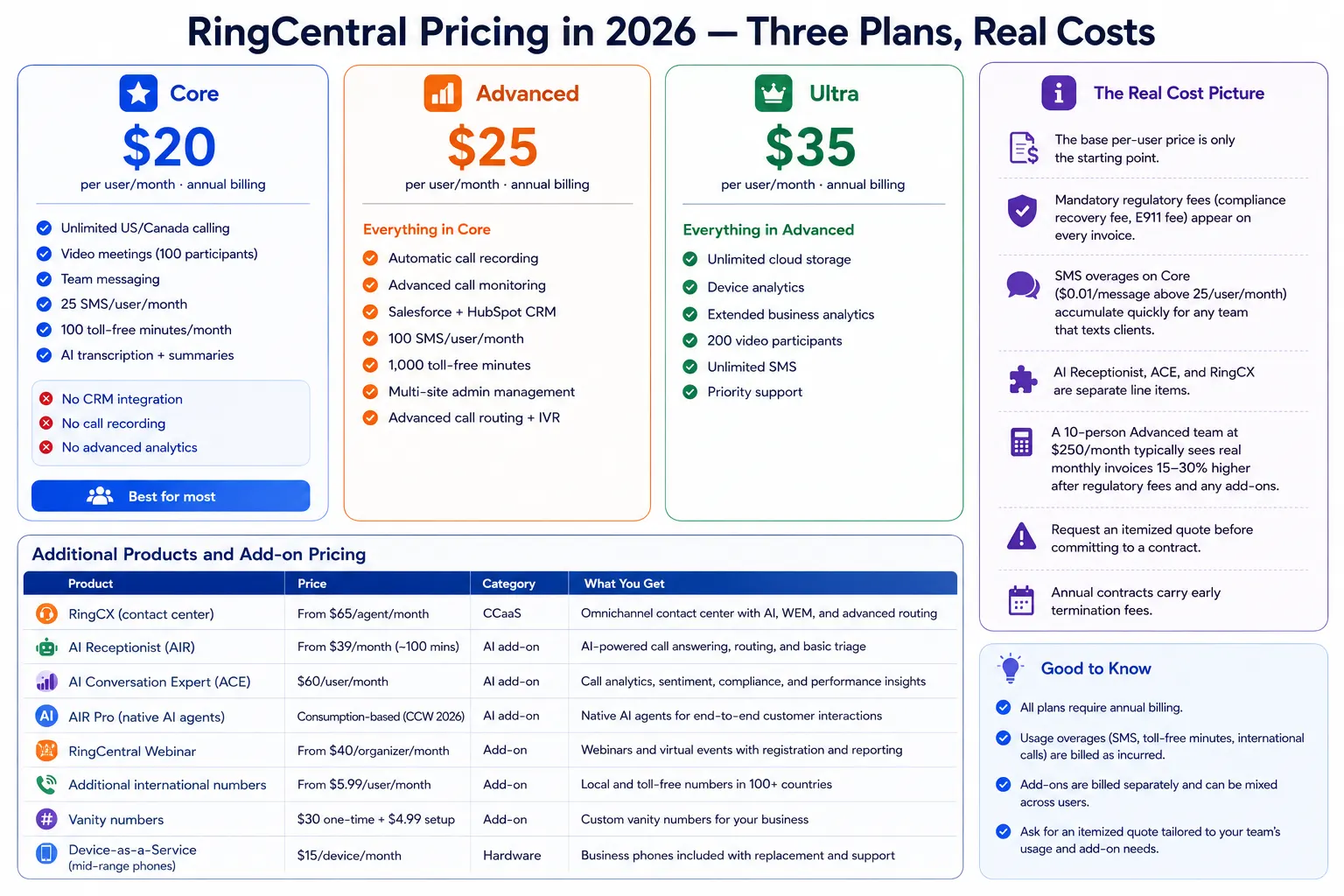
RingCentral pricing in 2026 — three plans, real costs
Who RingCentral is built for — and who should look elsewhere
Strong fit
- Mid-market and enterprise organizations (50–500+ users) needing one platform for all internal and external communication, particularly those with multiple offices or remote teams in different countries.
- Regulated industries — healthcare (HIPAA/HITRUST), financial services (PCI DSS), government (FedRAMP). RingCentral's compliance certifications are among the most comprehensive in the UCaaS market.
- Organizations replacing legacy PBX systems that want to eliminate hardware costs and gain modern features (mobile calling, AI transcription, CRM integration) without maintaining on-site infrastructure.
- Contact center operations that need the UC and CC layers from the same vendor. RingCX on top of RingEX avoids integration headaches between separate UC and CC systems.
- Global organizations with offices in multiple countries — RingCentral's PSTN coverage in 100+ countries and multi-site admin management make it one of the more practical choices for genuinely multinational deployments.
Look elsewhere if…
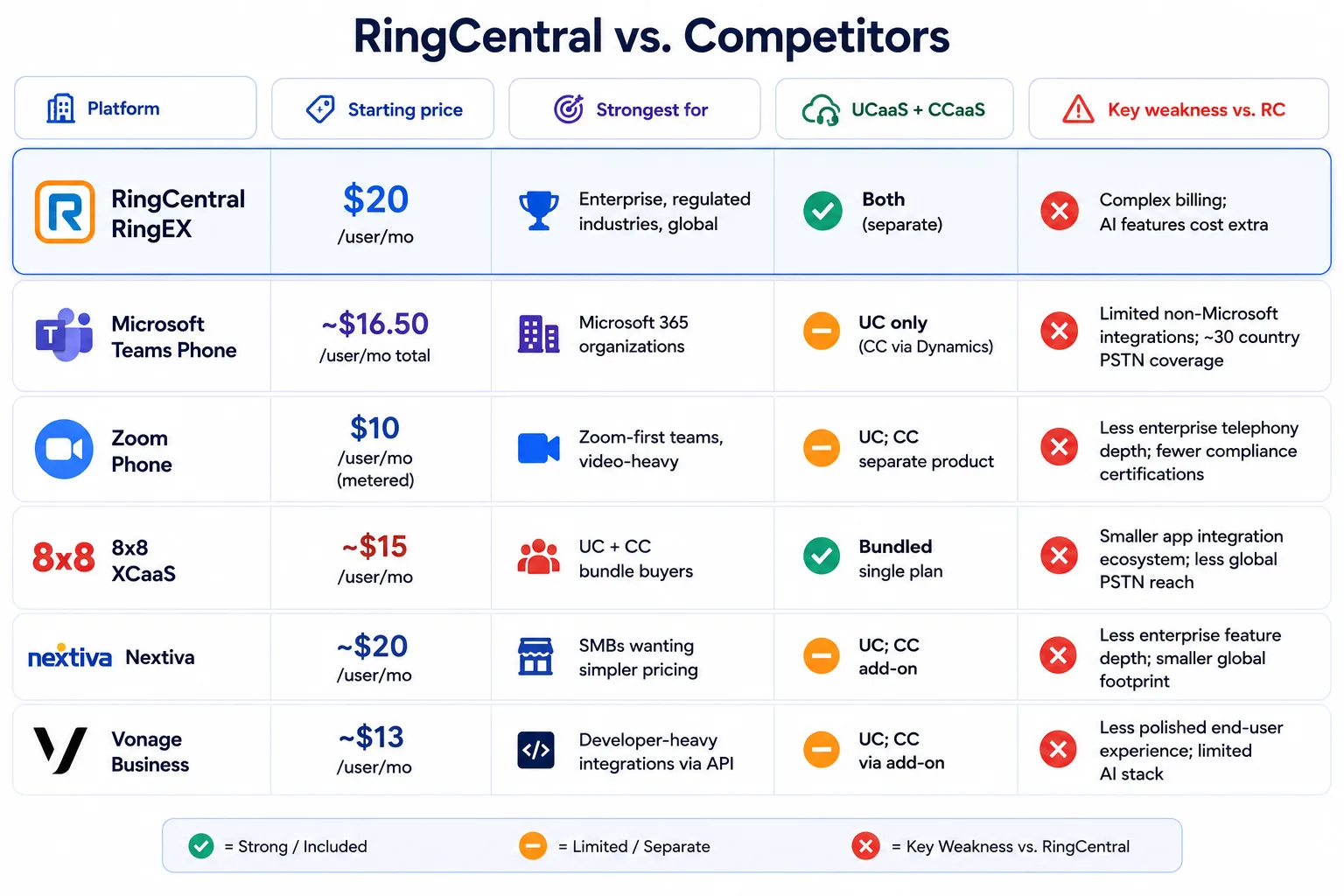
- Your organization is already fully on Microsoft 365 — Teams Phone at ~$16.50/user/month total cost (M365 Basic + Teams Phone + calling plan) is simpler and cheaper for organizations that don't need to leave the Microsoft ecosystem.
- You're a team under 20 users with straightforward calling needs — simpler VoIP providers like Grasshopper or GoToConnect cover basic requirements at significantly lower cost without the complexity.
- You want predictable, transparent billing — RingCentral's add-on model creates long invoices. If billing clarity is a priority, 8x8 XCaaS (which bundles UC and CC) or Nextiva may offer simpler cost structures.
- You need deep AI call automation beyond basic routing — RingCentral's AI Receptionist covers front-desk tasks, but complex multi-turn AI conversations and CRM function-calling at scale require RingCX + AIR Pro, which runs $65+/agent/month.
RingCentral vs. competitors