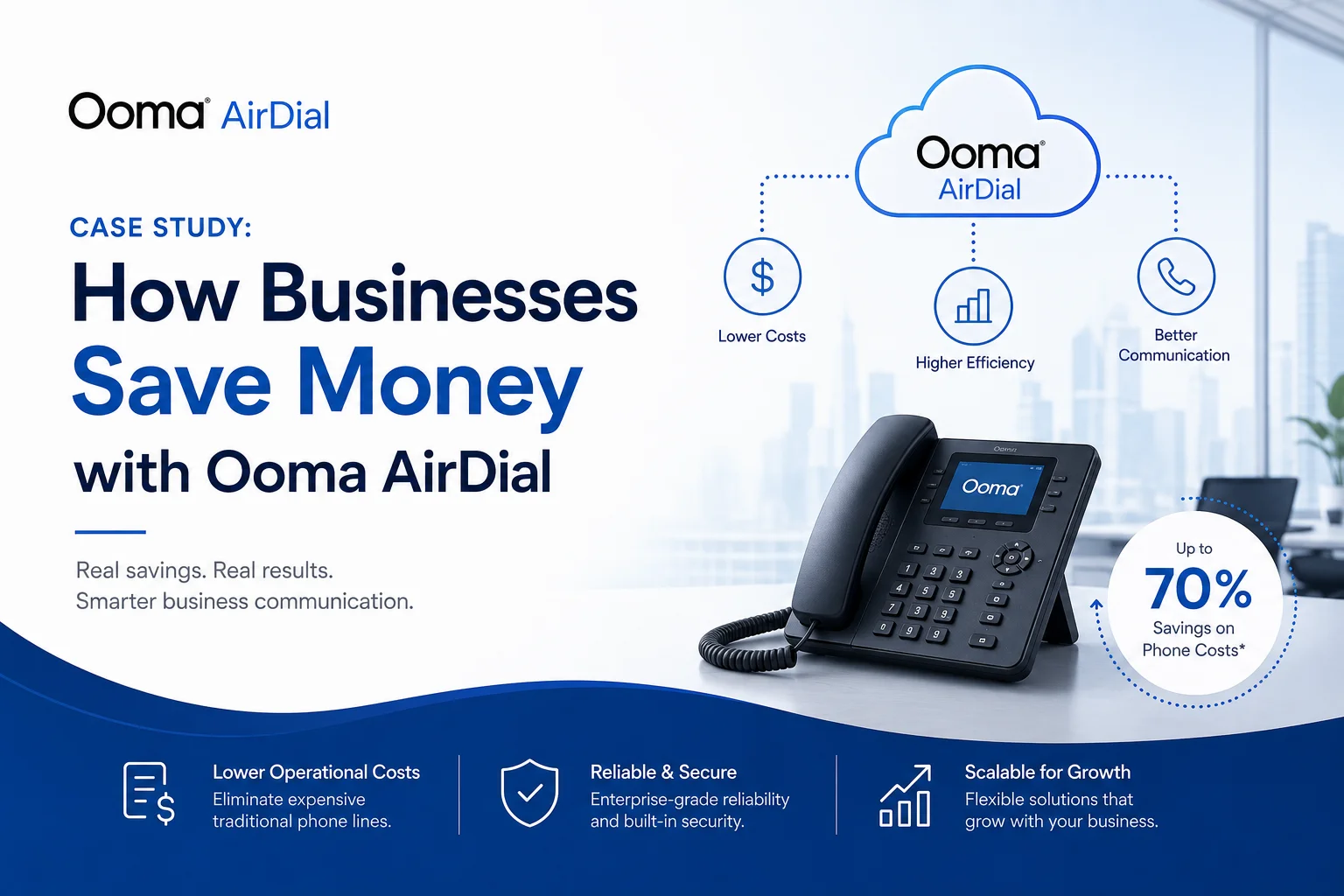
Case Study: How Businesses Save Money with Ooma AirDial — Real POTS Line Cost Reduction (2026)
Quick Answer: Businesses switching from traditional copper POTS lines to Ooma AirDial typically cut their monthly line costs by up to 60%. Real-world deployments across healthcare, senior living, property management, government, and education confirm savings ranging from hundreds to hundreds of thousands of dollars annually—without replacing existing analog devices or sacrificing life-safety compliance.
The Bill That Made a CIO Stop and Stare
Imagine opening your monthly telecom statement and finding a single analog fire alarm line billed at $849. That's not a typo. That's what Phoenix Senior Living encountered at one of their 46 southeastern U.S. communities—a single POTS line for a fire alarm panel, costing nearly $850 every month.
They're far from alone. Across the country, organizations with fire alarm panels, elevator emergency phones, building entry systems, fax machines, and other analog devices are discovering that the POTS lines keeping those systems connected have become shockingly expensive. Lines that cost $45/month a few years ago are now routinely billed at $200–$2,700/month per line, depending on carrier and location.
This isn't a billing mistake or a contract dispute. It's a structural market shift—and it's accelerating in 2026. Understanding why, and what organizations are actually doing about it, is what this article is for.
The POTS Crisis: What's Happening and Why It's Getting Worse
The Regulatory Trigger That Started Everything
In 2019, the FCC passed Order 19-72, removing pricing restrictions on Incumbent Local Exchange Carriers (ILECs) like AT&T, Verizon, and Lumen. That single ruling eliminated the requirement for carriers to maintain affordable copper line pricing—and they've been raising rates aggressively ever since.
POTS rates have climbed more than 20% from 2020 to 2025, and major carriers have announced further price hikes of up to 50% in the near term. The financial logic is deliberate: carriers want remaining copper customers to migrate voluntarily, so they price copper to be painful.
The 2025–2026 Acceleration
The situation escalated sharply in the past 18 months:
- October 15, 2025: AT&T stopped accepting new orders, moves, or changes for copper POTS services in select markets.
- December 2025: AT&T received federal approval to discontinue service at wire centers serving approximately 90,000 customers across 18 states—representing more than 30% of its copper footprint.
- March 2025: The FCC shortened the notice periods for copper wire center shutdowns from 180 to 90 days, accelerating pressure on organizations to migrate away from analog lines.
- 2026 onward: AT&T issued discontinuation notices announcing full discontinuation of copper POTS services beginning in June 2026, with a stated target to retire all copper by 2029. Lumen has issued grandfathering notices across 14 states as well.
Lines that once cost $45/month are now running anywhere from $200 to $2,700/month, depending on the carrier, location, and line type. And the problem isn't limited to voice lines—Legacy fire alarm circuits, elevator phone lines, fax lines, and gate systems are all caught in the same sunset.
One telecom broker put it plainly: We have been seeing exorbitant rate hikes (especially from the LECs), which are essentially creating unreasonable price increases for organizations. The hikes are borderline extortion and often times have been so high, customers are absolutely forced to migrate without any level of negotiation."
Who Gets Hurt Most
The organizations most exposed to POTS cost shocks are those with large portfolios of critical-device lines that can't simply be disconnected:
- Property managers with elevator phones, pool safety phones, and building entry systems across dozens or hundreds of buildings
- Healthcare organizations with fire alarm panels and nurse call systems across hospital campuses and clinic networks
- Senior living operators with fire, elevator, and emergency lines in every facility
- School districts and governments with alarm and emergency systems in every building
- Office building operators with elevator phones across entire portfolios
These organizations don't have the option of simply unplugging the POTS line. Life safety codes in most jurisdictions require these lines to be active, monitored, and compliant. Which is exactly why POTS replacement solutions like Ooma AirDial exist.
What Is Ooma AirDial?
Ooma AirDial is a plug-and-play cellular LTE gateway that replaces traditional copper POTS lines for analog devices—without requiring those devices to be replaced or rewired. You connect your existing fire alarm panel, elevator phone, fax machine, or gate entry system to the AirDial unit; the unit converts the analog signal and routes it over a private LTE cellular network.
The result: your analog devices keep working exactly as before, life-safety compliance is maintained, and your monthly line cost drops dramatically.
In May 2026, Frost & Sullivan named Ooma AirDial the 2026 Competitive Strategy Leader for POTS Replacement in North America, citing its "security, compliance, and functional robustness required to support critical devices." Ooma also received the Elevator World Ellie Award for Best Communication System Supplier in 2025 and the Channel Vision Visionary Spotlight Award in 2026.
Frost & Sullivan's research found that 50% of organizations surveyed in 2025 plan to increase investment in next-generation POTS replacement solutions by 2028—a clear signal that this migration wave is just beginning.
How AirDial Works: The Technology Behind the Savings
Patented MultiPath™ Technology
AirDial's reliability advantage comes from its patented MultiPath™ technology, which simultaneously routes analog traffic over both LTE cellular and wired Ethernet (where available). Frost & Sullivan highlighted MultiPath as a key AirDial differentiator, noting it "enables simultaneous use of wireless LTE and wired Ethernet connectivity where appropriate to reduce the likelihood of service disruption."
This matters for life safety compliance. Fire alarm and elevator phone lines cannot use the public internet—regulations require a private, monitored connection. AirDial's LTE path is entirely private, keeping it MFVN (Managed Facilities Voice Network) compliant as required by NFPA and other safety codes.
Battery Backup
AirDial integrates battery backup offering 16+ hours of uptime, expandable to 24+ hours.This exceeds requirements for most fire and elevator communication standards, which typically require 4–8 hours of backup power. During a power outage, the AirDial unit stays on independently of your building's power—your fire alarm remains monitored.
Remote Device Management (RDM)
Every AirDial unit is connected to Ooma's Remote Device Management web portal, giving IT and facilities teams real-time visibility across their entire device portfolio. The RDM portal provides full device visibility including status, LTE signal strength, and battery level, along with alerts for outages, battery issues, and calls, with role-based user permissions including access for external contractors.
For organizations managing dozens or hundreds of buildings, this centralized visibility is transformative. Instead of dispatching technicians to verify that a fire alarm line is working, a facilities manager can see the status of every AirDial unit—at every location—from a single browser tab.
Plug-and-Play Installation
AirDial ships pre-configured with service. Installation requires no new wiring and no specialized expertise. You connect the analog cable from your device to the AirDial unit, power it on, and it's live. Most organizations self-install their entire fleet during off-hours without service interruption.
Real-World Case Studies: Savings Across Every Industry
Healthcare: Clinic Network, 100 Sites, 650 Lines
A regional healthcare operator running 100 clinic locations had 650 POTS lines supporting fire alarm panels, nurse call systems, and emergency phones. Their monthly analog line bill had grown to approximately $60,000/month as carrier rates escalated.
After deploying Ooma AirDial across all 100 sites, their analog line expenses dropped significantly—costs fell to a fraction of the prior monthly spend while every device remained compliant and fully operational. The transition was completed without any interruption to clinical operations or life-safety monitoring.
The math here is straightforward: even at a conservative 50% reduction, the savings on a $60,000/month bill amount to $360,000 per year—enough to fund the hardware deployment many times over.
Senior Living: Phoenix Senior Living, 46 Communities
Phoenix Senior Living operates 46 senior care communities across the southeastern United States. Their situation represents the POTS crisis at its most acute: one fire alarm panel line alone had hit $849 monthly—a cost multiplied across hundreds of fire, elevator, and security lines in facilities where life-safety compliance is non-negotiable.
They chose Ooma AirDial specifically for its cost efficiency and Remote Device Management capabilities. The deployment gave their facilities team centralized visibility into every device across all 46 communities, while dramatically reducing the aggregate monthly line expense. Compliance with fire and elevator communication standards was maintained throughout.
Property Management: Brickpoint Properties
Brickpoint Properties, based in Stoneham, Massachusetts, manages a portfolio of residential and commercial buildings. Aging copper-wire phone lines supporting elevators, boiler rooms, fire alarms, entrance panels, and pool phones were escalating in cost and declining in reliability as AT&T's local infrastructure deteriorated.
Brickpoint Properties implemented Ooma AirDial across their properties, with 1,600 units deployed to ensure reliable operation of elevators, fire alarms, and other critical systems.The transition improved reliability while reducing costs—and the centralized RDM portal eliminated the reactive technician dispatches they'd been making to diagnose line problems.
Commercial Real Estate: CP Group
CP Group is one of the largest managers of office buildings in the United States. Elevator phone lines—required by ASME A17.1 for passenger safety—were generating escalating POTS bills across their entire portfolio.
After selecting Ooma AirDial to replace aging and expensive POTS lines servicing elevators, CP Group cut their elevator phone line costs by 50%. For a company of CP Group's scale, a 50% reduction in line costs across hundreds of buildings translates to substantial annual savings.
Property Management: Large Residential Portfolio, 2,000 Lines
A property management company operating 250 residential communities eliminated 2,000 traditional POTS lines by switching to AirDial. The result: annual savings in the hundreds of thousands of dollars, alongside improved reliability and centralized device monitoring across all 250 properties.
A conservative estimate: if those 2,000 lines averaged $200/month per line before the switch, the annual POTS spend was $4.8 million. At a 60% reduction, AirDial brings that to under $2 million—a $2.8 million annual difference.
Education: 130-School District, 250 Lines
A large school district educating more than 70,000 students in K–12 across more than 130 schools was frustrated with rapidly increasing monthly costs and poor service response from their legacy POTS provider. The equipment supported by those lines—fire alarm panels and burglar alarms—couldn't be allowed to go offline even for a single day during the school year.
After evaluating several POTS replacement solutions, the district chose Ooma AirDial for its superior remote management and MultiPath technology. AirDial passed a proof-of-concept test at two school sites, and the district was able to self-install more than 250 units at all 130 schools during the summer months.The transition was complete before the fall semester started—no classroom disruption, no compliance gap.
Government: West Coast City, 44 Sites
A West Coast city replaced emergency call boxes at 44 municipal sites with Ooma AirDial. The deployment delivered immediate cost savings while the city gained real-time device monitoring across all locations—a capability that didn't exist with their legacy copper lines. The project also served as a proof of concept for other government agencies evaluating POTS replacement at scale.
Many federal, state, and local agencies that have deployed AirDial reduce POTS-related telecom expenses by 60% or more, especially across large portfolios of buildings and facilities.
The Cost Comparison: Legacy POTS vs. Ooma AirDial
Here's what the economics actually look like in 2026:
What "60% Savings" Means in Practice
Organizations typically see 60% lower monthly phone bills compared to maintaining legacy analog lines when switching to Ooma AirDial. Here's what that looks like at different scales:
Hardware costs at these scales are recovered in 1–6 months of savings.
Why AirDial Delivers Savings That Last
Understanding why AirDial cuts costs so dramatically helps you build a stronger internal business case:
1. It bypasses the legacy telco rate structure entirely. POTS line prices are set by ILECs who face zero competitive pressure in markets where copper is the only remaining analog option. AirDial replaces the carrier relationship with a bundled cellular service priced to compete for your business.
2. All costs are bundled into one predictable bill. Hardware, cellular data, voice service, and monitoring are included in a single monthly rate. No surprise surcharges, no regulatory fee stacking, no equipment rental charges layered on top. One bill, one vendor.
3. Reliability reduces indirect costs. Failed POTS lines generate compliance violations, inspection failures, emergency technician dispatches, and potential fines. AirDial's MultiPath connectivity and battery backup dramatically reduce outage risk—and the RDM portal catches issues before they become service interruptions.
4. Remote management eliminates truck rolls. With legacy POTS, diagnosing a problem often means dispatching a technician. With AirDial's RDM portal, most issues are visible and diagnosable remotely. For organizations managing 50+ locations, this alone can save tens of thousands of dollars annually in maintenance labor.
5. You're not paying for depreciated copper. Carriers are investing nothing in their copper networks. They're extracting maximum revenue from remaining customers to fund copper retirement while building fiber and wireless infrastructure. Every year you stay on copper, you're subsidizing that retirement with inflating line charges.
6. Early migration locks in lower pricing. Organizations that migrate now, while they have options and time, negotiate better than organizations that wait until a 90-day discontinuance notice forces an emergency transition.
How to Build Your AirDial Business Case
Getting budget approval for a POTS migration project requires translating technical necessity into financial justification. Here's the framework:
Step 1: Inventory Your Lines
Start with a complete audit of every analog line in your portfolio. Categorize by:
- Device type (fire alarm panel, elevator phone, fax, gate entry, emergency phone, POS terminal)
- Location/building
- Current carrier and monthly rate per line
- Compliance standard applicable (NFPA 72, ASME A17.1, UL 864, etc.)
Most organizations discover they have more analog lines than expected—especially in buildings that have been expanded or renovated over the years. This inventory also identifies lines that may no longer be needed, which can mean immediate savings before AirDial is even deployed.
Step 2: Calculate Your Current Annual Spend
Multiply your per-line cost by line count by 12. Don't use last year's rates—use your current rates, because they're likely to be higher than next year's rates on copper. Factor in any additional carrier fees, regulatory surcharges, and maintenance costs.
Step 3: Model AirDial Costs
Request a quote from Ooma for your line count. The pricing model bundles hardware (one-time) plus monthly service per device. Use a realistic per-line rate from Ooma's quote to calculate:
- Total hardware investment (one-time)
- Annual service cost (monthly rate × 12 × number of lines)
Step 4: Calculate Savings and Payback Period
For most deployments, the hardware investment is recovered in 1–6 months of savings. After payback, the savings are pure reduction in operating expense.
Step 5: Use Ooma's Free Business Case Builder
Ooma offers a free Business Case Builder tool where organizations can input their existing POTS line count and costs to generate a customized savings projection, ROI analysis, and payback period calculation—no login required, takes about 2–3 minutes.The tool generates a shareable PDF document suitable for presenting to finance or facilities leadership.
Step 6: Frame the Risk Argument Alongside the Savings Argument
For many organizations, the financial case for POTS migration is actually secondary to the risk case. Decision-makers outside IT care about three things: cost, compliance, and risk. Your business case should address all three:
- Cost: Quantified savings over 1, 3, and 5 years
- Compliance: AirDial is certified to NFPA 72, ASME A17.1, UL 864—it maintains or improves current compliance posture
- Risk: With AT&T actively discontinuing copper services beginning June 2026, staying on POTS creates real service disruption risk with as little as 90 days' notice. An emergency migration under a discontinuance notice is more expensive and more disruptive than a planned one.
Beyond Cost Savings: What Else AirDial Delivers
The financial case tends to dominate the conversation, but organizations that have deployed AirDial at scale consistently report additional benefits:
Operational Visibility They Never Had Before
With traditional POTS lines, you often didn't know a line had failed until someone tried to use it—or a fire marshal inspected and found it non-compliant. AirDial's RDM portal sends real-time alerts when signal strength drops, battery levels are low, or a device stops responding. Proactive monitoring replaces reactive emergency response.
Single-Vendor Simplicity
Managing POTS typically means coordinating with a phone carrier for line service, a hardware vendor for device maintenance, and an ISP for any internet-based backup. AirDial consolidates hardware, LTE data, and voice service under one vendor—one contract, one invoice, one support call when something needs attention.
Compliance Documentation
AirDial generates logs of device status, call activity, and connectivity events that can be exported for compliance documentation. When an inspector asks about your fire alarm communication system, you have records.
Scalability
Adding a new building to your AirDial deployment is straightforward: order a unit, plug it in, and it registers automatically. There's no carrier provisioning delay, no technician dispatch to install a copper pair, no waiting weeks for service to be established.
Ooma AirDial in 2026: Industry Recognition
The POTS replacement market has attracted several competitors, but Ooma AirDial's position was validated by a significant external endorsement:
On May 19, 2026, Frost & Sullivan announced that Ooma received the 2026 North American Competitive Strategy Leadership Recognition in the POTS-replacement industry for its outstanding achievements in innovation, strategy execution, and customer impact.
Frost & Sullivan's Elka Popova noted: "AirDial is a purpose-built replacement solution for mission-critical use cases such as fire alarms, elevators, emergency phones, fax, and point-of-sale systems. This approach enables Ooma to address a segment underserved by traditional IP telephony and UCaaS solutions—without compromising security, privacy, and compliance."
The same Frost & Sullivan report noted that many existing offerings address only narrow use cases or limited device types"—a pointed observation about competitors that position themselves as POTS replacements but don't support the full range of life-safety applications.
Ooma AirDial also holds the Elevator World Ellie Award for Best Communication System Supplier (2025) and the Channel Vision Visionary Spotlight Award for End User Portal (2026).
Conclusion: The Window for Proactive Migration Is Closing
The economics of staying on copper POTS lines in 2026 don't work. Rates for existing lines are already spiking, in some cases exceeding $2,700 per line per month, and AT&T began full discontinuation of copper POTS services in June 2026. With Lumen not far behind and the FCC reducing carrier notice requirements to 90 days, the question is no longer whether to migrate off copper—it's whether you migrate on your terms or on your carrier's.
The case studies in this article tell a consistent story across industries: organizations that made the switch to Ooma AirDial cut monthly line costs by 50–60%, eliminated reactive maintenance headaches, gained real-time visibility into devices they previously couldn't monitor, and maintained or improved compliance with fire and elevator safety codes.
For a company spending $10,000/month on POTS lines, that's $72,000–$84,000/year back in budget—with hardware paid back in months, not years.
The right next step is to know your own numbers. Take 3 minutes to run your current POTS spend through Ooma's Business Case Builder, or contact Ooma's team for a custom savings analysis. The copper era is ending whether organizations plan for it or not. The ones that plan for it save significantly more money in the process.
Ready to calculate your savings?
- Use Ooma's free Business Case Builder — no login, results in 3 minutes
- Request a custom savings analysis from an Ooma AirDial specialist
- Download the Frost & Sullivan 2026 POTS Replacement report at ooma.com/airdial