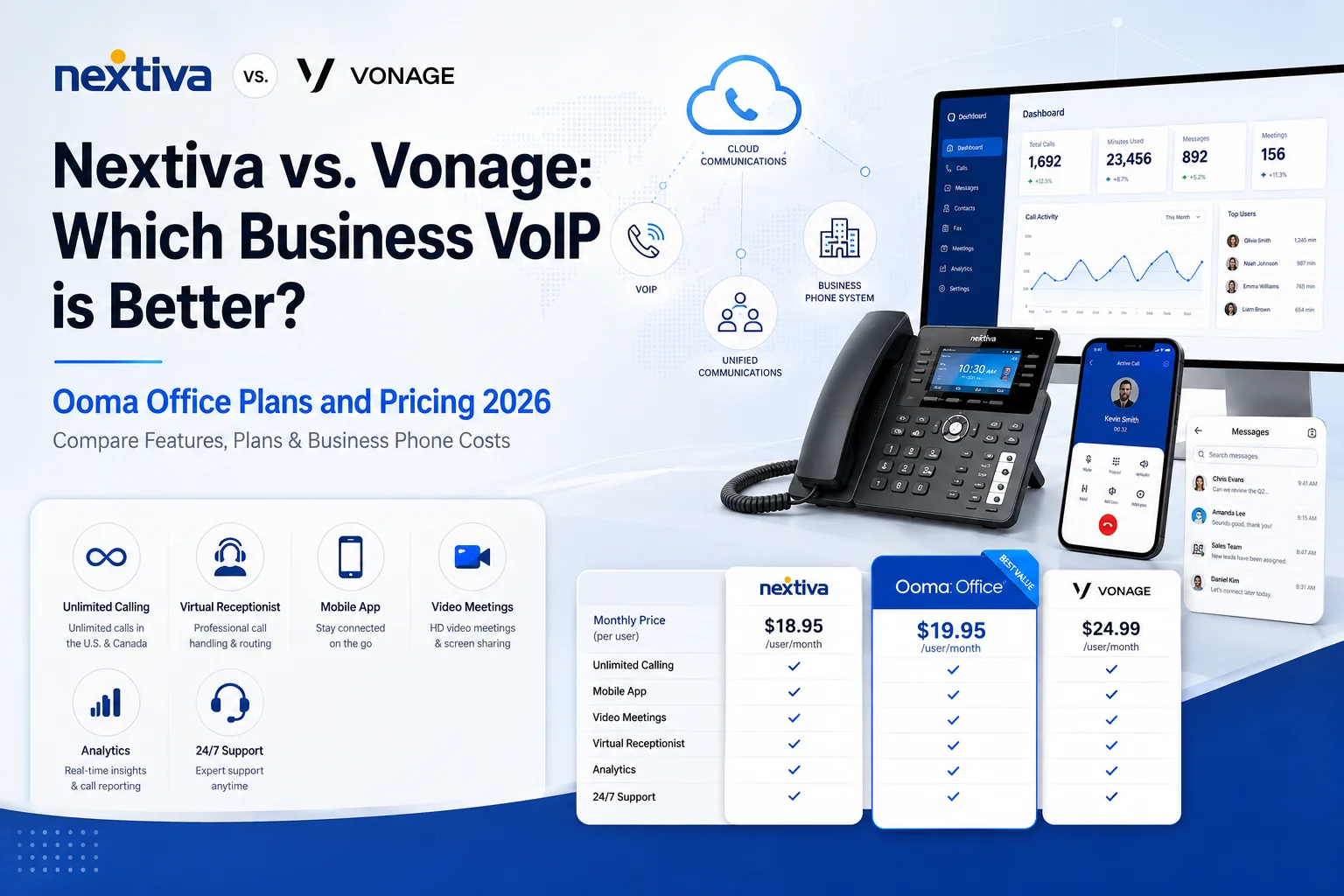
Nextiva vs. Vonage 2026: Which Business Phone System Is Actually Worth Your Money?
If you've spent any time researching business VoIP providers, you've probably landed on both of these names more than once. Nextiva and Vonage are two of the most established players in the cloud phone space, and on paper they look almost interchangeable — unlimited calling, video meetings, team chat, CRM integrations, the works. But once you get past the marketing pages and into actual pricing tiers, contract terms, and real user experiences, the differences start to matter a lot.
I dug into both platforms' current 2026 pricing, feature sets, and third-party reviews to figure out where each one genuinely pulls ahead — and where the sales page oversells things. Here's the honest breakdown.
What Is Business VoIP, Exactly?
Business VoIP lets your company make and receive calls over the internet instead of copper phone lines, while bundling in tools like voicemail transcription, auto-attendants, and video conferencing into one subscription. Most providers today package these features together under the label UCaaS (Unified Communications as a Service) — a single platform that handles voice, video, and messaging instead of stitching together separate vendors.
Nextiva and Vonage both fall into this category. They give you a cloud PBX, desktop and mobile apps, and the ability to answer a business call from your laptop at a coffee shop just as easily as from a desk phone in the office.
Nextiva Overview: Built for Reliability and Support
Nextiva has spent over 15 years building out a communications platform that now serves roughly 150,000 businesses, and its reputation largely comes down to two things: uptime and support quality. Nextiva restructured its lineup in early 2026, consolidating what used to be four small-business tiers into three core plans — Core, Engage, and Scale — alongside a separate per-agent contact center product for larger operations.
Every Nextiva plan includes unlimited calling across the US and Canada, a multi-level auto-attendant, HD voice, and a published 99.999% uptime SLA. Even the entry-level Core plan gives you call routing, business SMS, video meetings, and team chat — the essentials most competitors gate behind a pricier tier.
Where Nextiva really separates itself is at the higher end: the Engage and Scale plans add AI-powered call transcription, an AI receptionist that can field incoming calls, and a reporting suite with dozens of dashboards for tracking team performance. Nextiva's visual, drag-and-drop call flow builder also means you can set up department routing or after-hours rules without touching a line of code.
For integrations, Nextiva connects natively to Google and Outlook contacts on every plan, with Salesforce, HubSpot, Zendesk, and Microsoft Teams available as add-ons on higher tiers. It also supports single sign-on and Active Directory sync for businesses that need tighter IT control.
Vonage Overview: Built for Global Reach
Vonage Business Communications (VBC) — now operating as part of Ericsson — takes a different approach. Rather than bundling everything into one plan, Vonage keeps its three tiers, Mobile, Premium, and Advanced, fairly lean, and expects you to add capabilities as you need them through its App Center marketplace.
Mobile is essentially an app-only plan: good for a small team that just needs to make and take calls without a desk phone. Premium is where things get interesting for most businesses — it adds desk phone support, video meetings for up to 200 participants, team messaging, and native integrations with Salesforce, Microsoft 365, and Google Workspace. Advanced layers on call recording, visual voicemail with transcription, and more advanced call management.
Vonage's real strength is international reach. It runs a global network of data centers and offers competitive per-minute rates to more than 60 countries, which matters a lot if your team regularly calls clients or offices overseas. It also has a genuinely useful Microsoft Teams integration — you can either add Vonage calling directly into Teams or use it to replace Teams' built-in calling entirely.
Vonage also sells developer-facing APIs for messaging and voice (its CPaaS product), which is a category Nextiva doesn't really compete in. If your business builds custom communication workflows into its own software, that's worth knowing.
Both providers support standard desk phone hardware from Cisco, Yealink, Poly, and Grandstream, so switching from a legacy office phone system doesn't necessarily mean throwing out your handsets.
Pricing & Plans: What You'll Actually Pay in 2026
This is where the "starting at" prices on both companies' homepages can be misleading. Here's what the current tiers actually look like, along with the catch behind each headline number.
A few things worth flagging before you commit to either:
- Nextiva's $15 headline price requires annual billing, a 12-month minimum contract, and new-customer status. Most businesses that need call recording or decent reporting actually end up on Engage, which runs $25–$50/user depending on billing cycle.
- Vonage's advertised prices don't include mandatory fees. Budget for a per-extension regulatory fee, 911 service charges, and federal surcharges on top of the base rate — plus separately priced add-ons like automatic call recording (~$50/month) and call queues (~$15/month) if you're not on the top tier already.
- Both providers add USF (Universal Service Fund) and local tax pass-throughs, which commonly add 7–12% to your final invoice regardless of which plan you pick.
Bottom line on pricing: Nextiva bundles more into its base tiers (call recording, reporting, video) at a comparable price point, while Vonage keeps its entry plan cheaper but pushes core features like recording and desk phone support into higher tiers.
Calling Features: Where the Two Actually Differ
Unlimited domestic calling, call forwarding, hold music, and voicemail are table stakes for both platforms. The gap shows up in the details.
Nextiva includes call recording on all paid plans (not just its top tier) and its voicemail-to-text transcription is consistently rated as one of the more accurate ones in the industry. Its call flow builder supports business-hours logic, holiday schedules, and department-specific menus without needing a developer, and it offers automatic failover routing to a cell phone if your primary line goes down.
Vonage's core plans include unlimited calling and basic three-level IVR, but video conferencing and more advanced call handling don't show up until Premium. Where Vonage genuinely pulls ahead is on international rates — if you're regularly dialing outside North America, its per-minute pricing to 60+ countries is hard to beat. Power dialers and predictive dialing exist, but they're either reserved for higher tiers or sold as separate App Center add-ons.
Messaging & Collaboration
Both platforms treat texting and chat as first-class features rather than afterthoughts.
Nextiva includes unlimited business SMS/MMS and a team chat app with group messaging, file sharing, and built-in video calls on desktop and mobile. Vonage's messaging setup is similar but centers around what it calls the Business Inbox — a single thread that combines SMS, web chat, and social messaging so your team isn't juggling five different apps to answer a customer. Vonage's team messaging and deeper collaboration tools are part of the Premium plan and integrate cleanly with Slack and Microsoft Teams.
Neither provider charges per-message fees for standard US texting, so this one's largely a wash — the real question is whether you prefer Nextiva's all-in-one chat app or Vonage's unified inbox approach.
Integrations & Add-Ons
Nextiva keeps native integrations relatively focused — Outlook and Google Contacts sync are included everywhere, with Salesforce, HubSpot, Zendesk, and Microsoft Teams available as paid add-ons on higher tiers. Its AI analytics platform, XOXO, transcribes calls automatically and surfaces sales or support insights without extra configuration.
Vonage's App Center is broader out of the box. Salesforce, Microsoft Dynamics 365, Zoho, Zendesk, Slack, and Google Workspace all connect natively, and its Microsoft Teams integration is genuinely one of the better ones on the market — you can route Vonage calling directly through Teams instead of running two separate apps. If your team is deep in the Microsoft or Salesforce ecosystem already, Vonage's out-of-the-box coverage will likely save you setup time.
Call Quality & Reliability
Both companies advertise a 99.999% uptime SLA, and in day-to-day use, most users on both platforms report clear, reliable calls — assuming your office internet connection is solid. VoIP quality lives and dies by your network, so a decent business-grade router and some basic QoS configuration will do more for call clarity than which provider you pick.
That said, there are some meaningful differences. Nextiva's jitter buffering and adaptive audio handling get consistently good marks in independent testing, and several reviewers specifically note clearer audio after switching from Vonage. Vonage counters with SmartWAN and SD-WAN options that prioritize voice and video traffic and build in automatic failover paths — genuinely useful if your office has a spotty internet connection or you're managing multiple locations.
Practical tip: whichever provider you choose, ask about their recommended router/firewall setup during onboarding, and don't skip configuring Quality of Service (QoS) rules to prioritize voice traffic on your network. It's a five-minute setup that prevents most of the "choppy call" complaints you'll see in reviews.
User Reviews & Support: The Gap Is Real
This is the category where the two providers diverge the most, and it's not close.
As of mid-2026, Nextiva sits at roughly 4.6 out of 5 on Trustpilot across more than 8,000 reviews, with customers consistently calling out fast onboarding and responsive 24/7 support — support that's included on every plan rather than sold as an upgrade.
Vonage's business service, by contrast, currently sits around 2.2 out of 5 on Trustpilot across more than 1,500 reviews, with recurring complaints about long support wait times, billing surprises, and difficulty canceling service. (Vonage's home/consumer product is rated separately and scores noticeably better, so make sure you're comparing business reviews specifically if you go looking.) On G2 and Capterra, Vonage scores more respectably — around 4.0/5 — with users praising ease of use and call quality but flagging the same support and pricing-transparency issues that show up on Trustpilot.
If 24/7, US-based support with fast response times is a priority for your team, this is probably the single biggest factor tilting the decision toward Nextiva.
Nextiva vs. Vonage: Pros & Cons at a Glance
Which One Is Better for Your Business?
There's no universal winner here — it comes down to what your team actually needs day to day.
Choose Nextiva if:
- You're a small-to-midsize business focused mainly on domestic (US/Canada) calling
- You want call recording, video conferencing, and reporting included without stacking add-ons
- Fast, reliable 24/7 support matters more to you than the cheapest possible entry price
- You need HIPAA-eligible communications or stronger built-in security (Nextiva offers AES-256 encryption and SOC 2 audit compliance)
Choose Vonage if:
- Your team regularly calls international clients or offices, and competitive per-minute rates matter
- You're already embedded in Microsoft Teams or Salesforce and want the integration to feel native
- You need developer-level API access for custom communication workflows
- You're comfortable building out your plan with App Center add-ons rather than getting everything in one bundle
Enterprises already standardized on Microsoft Teams might lean toward Vonage's calling integration, while companies that want a single reliable platform without piecing together add-ons tend to land on Nextiva. Either way, both providers offer trial periods or live demos — Nextiva typically runs a shorter 7-day trial, while Vonage's demo process tends to involve a sales call rather than instant self-signup. Test each one with your actual office network before signing a 12-month contract; that's the only way to really judge call quality for your specific setup.
The Bottom Line
Nextiva and Vonage are both legitimate, established UCaaS platforms — this isn't a case of one being obviously better across the board. Nextiva earns its reputation through dependability: more features bundled into lower tiers, a stronger uptime and support track record, and pricing that stays relatively predictable once you factor in what you'd otherwise pay extra for elsewhere. Vonage earns its place through flexibility: better international rates, a wider net of native integrations, and an API platform for teams that want to build something custom.
Before you sign anything, write down your must-have features — call recording, international minutes, specific CRM integrations, whatever matters most to your workflow — and check them against each plan tier rather than the marketing headline. That one step will save you from discovering a "missing feature" three months into a 12-month contract.