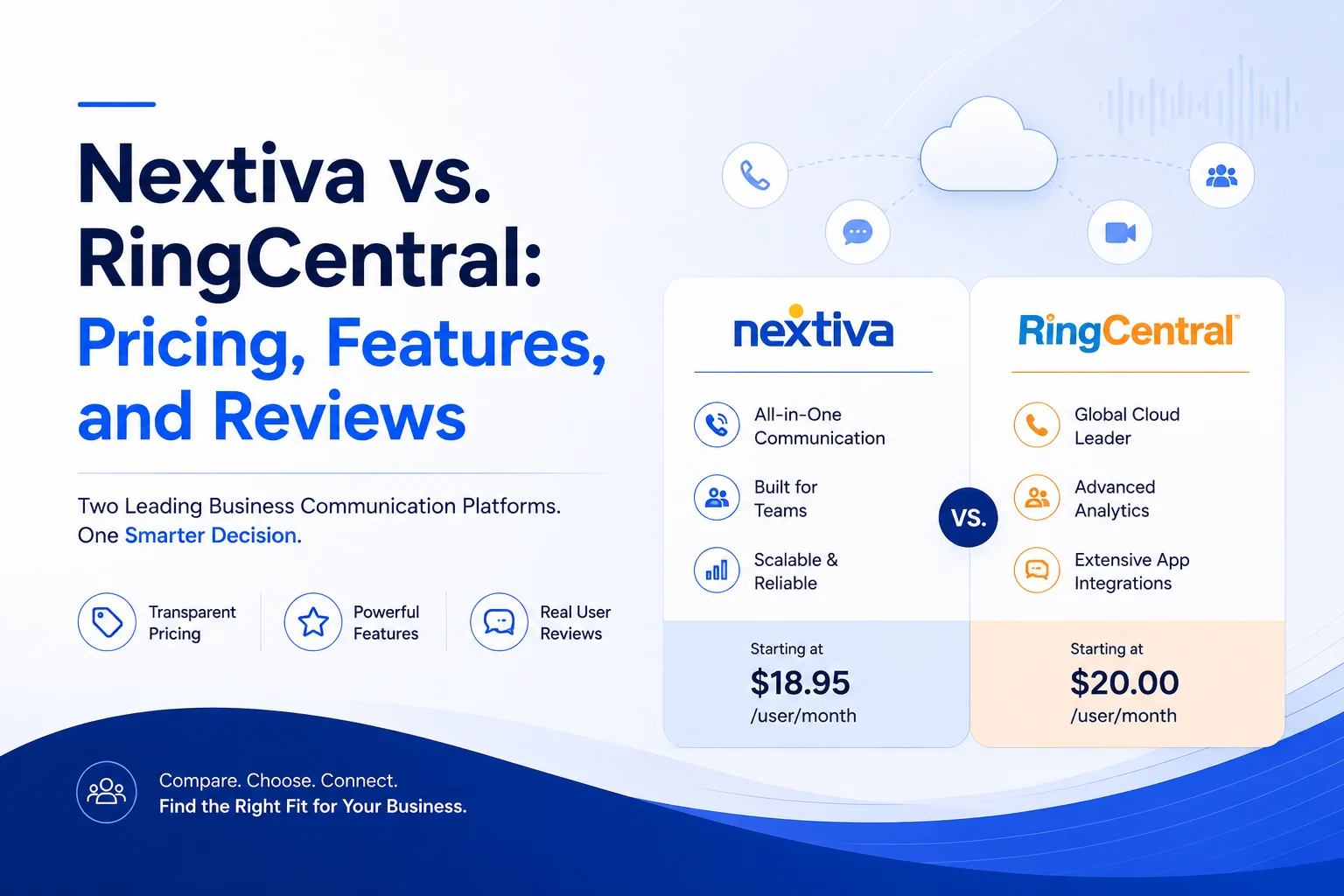
Nextiva vs RingCentral (2026): Which Business Phone System Actually Wins?
If you've spent any time researching cloud phone systems, you've probably noticed that Nextiva and RingCentral keep showing up at the top of every "best VoIP" list. That's not an accident — both have been around for decades, both serve six-figure customer bases, and both genuinely work. But "both are good" doesn't help you pick one for your team.
I dug into current pricing pages, feature breakdowns, and thousands of verified reviews on Trustpilot and G2 to figure out where these two platforms actually diverge. Short version: Nextiva wins on price and customer satisfaction, RingCentral wins on integrations and meeting capacity, and the right choice depends almost entirely on how big your team is and what you're using the phone system for.
Here's everything you need to know before you commit to either one.
Quick Answer: Nextiva vs RingCentral at a Glance
Nextiva is the better pick if you're a small or mid-sized business that wants dependable calling, strong analytics, and support that doesn't leave you on hold for an hour. RingCentral makes more sense for larger, distributed teams that need a massive app ecosystem (300+ integrations) and can tolerate a steeper learning curve and rockier support reputation.
Now let's break down why those numbers look the way they do.
Pricing Comparison: What You'll Actually Pay
Pricing is usually the first filter for anyone comparing VoIP providers, so let's start there.
RingCentral's RingEX platform runs three tiers, all billed per user per month with an annual-billing discount:
- Core – $20/user/month (annual) or $30/month-to-month
- Advanced – $25/user/month (annual) or $35/month-to-month
- Ultra – $35/user/month (annual) or $45/month-to-month
Nextiva restructured its small-business lineup in early 2026, collapsing what used to be four tiers into three:
- Core – $15/user/month (annual) or $23/month-to-month
- Engage – $25/user/month (annual) or $50/month-to-month
- Scale – $75/user/month (annual)
At the entry level, Nextiva is meaningfully cheaper — about 25% less than RingCentral's Core plan. The two providers land at the same $25/user price point in the middle tier, though the feature sets diverge (more on that below). At the top end, the comparison flips: RingCentral's Ultra plan tops out at $35/user, while Nextiva's Scale plan jumps to $75/user because it's bundling in full contact-center capability rather than just adding a few extra features.
A pricing caveat worth flagging: neither company's advertised rate is the number you'll see on your invoice. Nextiva's own guidance says taxes and regulatory fees typically add 15–25% on top, and RingCentral's month-to-month pricing runs roughly 30–40% higher than the annual rate. Budget for that gap before you sign a contract, and always ask for the fully loaded monthly cost — not just the sticker price — when comparing quotes.
Bottom line: If you're a lean team that just needs reliable calling and messaging, Nextiva's Core plan stretches your budget further. If you expect to need call recording, CRM integrations, or multi-site management soon, compare the mid-tier plans directly rather than the entry-level ones, since that's where the real value trade-offs show up.
Feature Comparison: Telephony, Collaboration & Analytics
Both platforms cover the fundamentals — auto-attendant, call routing, voicemail transcription, video meetings, team chat, SMS. The differences show up in the details.
Telephony and Call Management
RingCentral's Core plan includes unlimited domestic (US/Canada) calling, a full IVR system, and video meetings for up to 100 participants right out of the gate. It also bakes in single sign-on and access to its 300+ app marketplace even at the base tier — a genuine advantage if your team already lives in Salesforce, HubSpot, or Microsoft 365.
One thing to watch: RingCentral caps SMS at just 25 messages per user per month on Core. That sounds fine until you realize a single appointment-reminder workflow can burn through it by midweek. If your team texts customers regularly, you'll likely need to move up to Advanced or budget for SMS add-ons.
Nextiva's Core plan covers unlimited calling, auto-attendant, and voicemail transcription through its NextivaONE app, and includes 100 SMS messages per user per month — four times RingCentral's allotment at a similar price point. Nextiva also tends to pack more into call routing flexibility (simultaneous and sequential ringing, priority routing) without forcing you into a pricier tier.
If your priority is a contact center, both providers gate it behind their top plans: Nextiva's Scale tier adds AI-powered call summaries and skills-based routing, while RingCentral keeps contact-center tools in Ultra but also sells a separate, more robust product called RingCX for higher-volume operations.
Collaboration and Team Tools
This is where RingCentral pulls ahead. Its video meetings scale from 100 participants on Core to 200 on Ultra, compared to Nextiva's roughly 25-person cap on most plans. If webinars or large all-hands meetings are a regular part of your workflow, that gap matters. RingCentral also layers in web-based chatbots and in-call customer surveys, which service teams often use for feedback collection.
Nextiva's collaboration tools are more modest in scale but stronger in analytics. Its dashboard pulls data across calls, chat, and social channels into one view, which makes it easier for a manager to spot call-volume trends or agent performance issues without stitching together multiple reports. Reviewers consistently describe Nextiva's analytics as more approachable for non-technical admins, even if RingCentral's higher-tier "Business Analytics Pro" suite is more granular.
Practical takeaway: If you need big meetings and broad software integrations, RingCentral's base plan gives you more out of the box. If you'd rather have clean, actionable reporting without hiring someone to configure it, Nextiva has the edge.
Feature Comparison Table
User Reviews & Satisfaction: The Gap Is Hard to Ignore
This is the part of the comparison that tends to surprise people. On paper, both platforms look similar in feature depth. In practice, customer sentiment is not close.
- Trustpilot: Nextiva sits around 4.6/5 across more than 8,000 reviews — an "Excellent" rating. RingCentral sits around 1.8/5 across roughly 1,900 reviews — a "Poor" rating.
- G2: Nextiva scores about 4.5/5 from 3,500+ reviews; RingCentral scores roughly 4.2–4.3/5 from around 1,400 reviews. Nextiva also consistently outscores RingCentral on G2's "quality of support" metric (often 9.0 vs. the high-7s).
- Capterra: Similar pattern — Nextiva above 4.5, RingCentral closer to 4.2.
The disconnect between the two review platforms tells its own story. G2 and Capterra reviewers, who are mostly rating day-to-day product experience, see the two platforms as fairly close in quality. Trustpilot, which skews toward people who had a strong reaction (often after trying to cancel or resolve a billing issue), paints a much starker picture for RingCentral. The recurring complaints there are auto-renewing annual contracts, difficulty deactivating licenses, and slow responses from support — not call quality or dropped calls.
Nextiva's reviews lean the opposite direction: people frequently mention fast, competent support and an easy setup process, though a subset of reviews flag early-termination fees and account auto-renewal as pain points — so it's not without its own contract friction.
Practical tip: Before signing with either provider, read the cancellation and auto-renewal terms carefully, and get them in writing. This single issue accounts for a large share of the negative reviews for both companies, and it's entirely avoidable if you know what you're agreeing to upfront.
Which Is Best for Your Business?
Small to Mid-Size Businesses
Nextiva is the more practical default. The $15/user Core plan covers essential calling and messaging affordably, the analytics dashboard gives you visibility without extra tools, and the support experience — based on review data — is meaningfully less frustrating. This is a solid fit for professional services firms, small consultancies, and teams that want a phone system that just works.
Larger or Distributed Teams
RingCentral's broader integration library (300+ apps vs. Nextiva's more limited set) and larger video meeting capacity make it a better structural fit for organizations with multiple offices, dedicated IT support, and existing investments in tools like Salesforce or Microsoft Teams. Just budget extra time for onboarding and go in with realistic expectations about support response times.
Contact Centers and Heavy AI Use
If a true contact center is the goal, compare the add-on costs carefully rather than the base plans. Nextiva's Scale plan ($75/user) bundles AI transcription, call summaries, and skills-based routing into one price. RingCentral offers similar capability through its separate RingCX product and an AI Receptionist add-on (roughly $39+/month extra), which means your final cost depends heavily on which AI features you actually need.
Both providers offer a way to test-drive before committing — RingCentral runs a 14-day free trial, and Nextiva typically offers guided demos through its sales team. Use them. A 20-minute walkthrough with your own call flows will tell you more than any comparison article, including this one.
The Bottom Line
Both Nextiva and RingCentral are established, reliable UCaaS platforms — you won't end up with a broken product either way. But the data points in a fairly clear direction: Nextiva offers better value and a noticeably better support experience for small and mid-sized teams, while RingCentral justifies its higher price for larger organizations that need its integration depth and meeting scale.
Whichever way you lean, don't skip the trial or demo, and read the contract terms on auto-renewal and cancellation before you sign. That single step will save you from becoming one of the frustrated reviews you just read about.