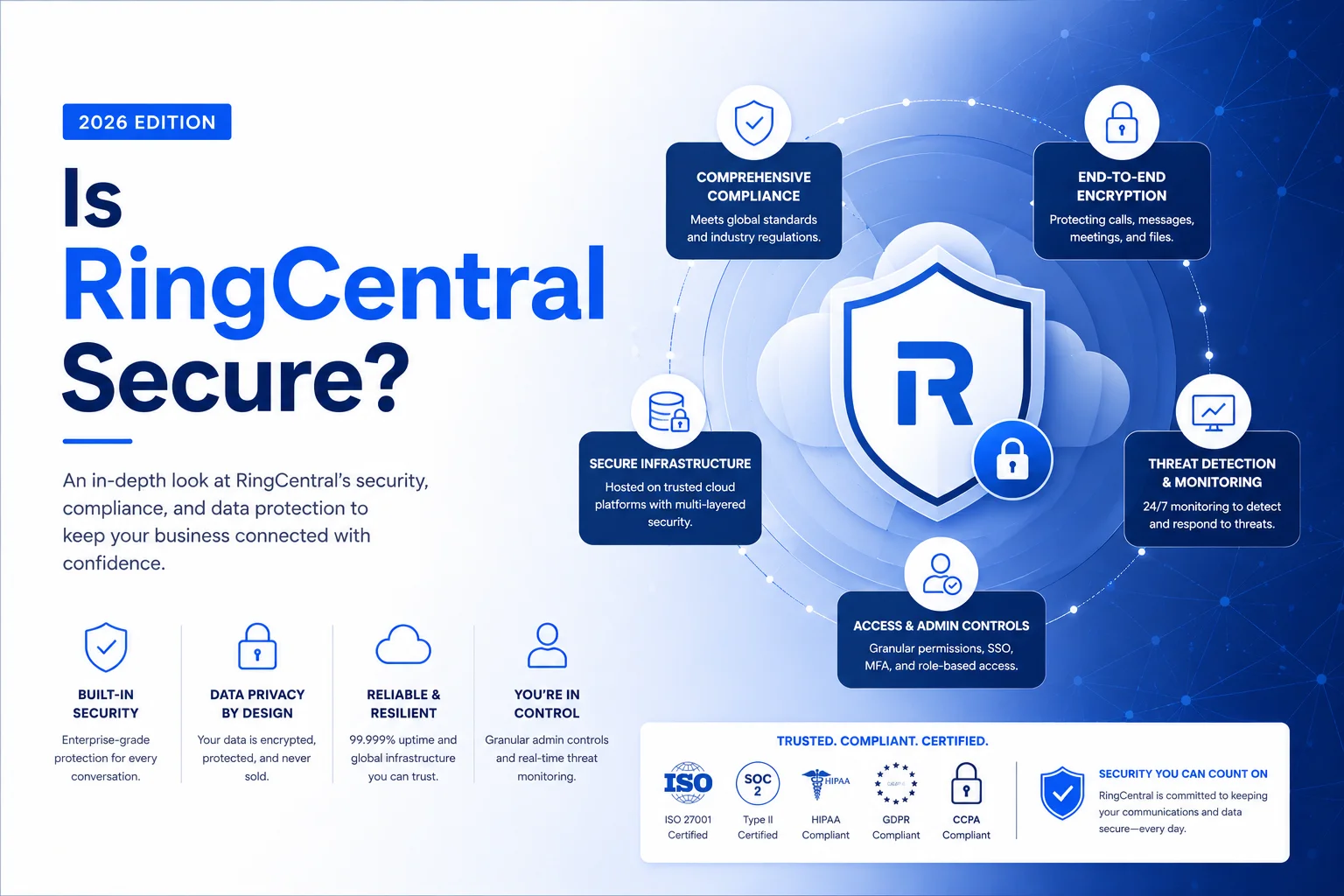
Is RingCentral Secure? How TLS, SRTP, and MFA Protect Your Business Communications
If you're evaluating RingCentral for your organization, security isn't a checkbox — it's a prerequisite. Breached business phone systems don't just expose conversations; they expose customer data, internal processes, and in regulated industries, legal liability.
The direct answer: yes, RingCentral is a secure platform. But "secure" means different things in different contexts. This guide explains exactly how RingCentral protects your calls, messages, and stored data — the protocols it uses, the compliance certifications it holds, the features you need to configure, and the realistic limitations every administrator should understand.
How RingCentral Encrypts Your Communications
Encryption is the foundation of any trustworthy communications platform. RingCentral applies it at three distinct layers: in transit, in real time, and at rest.
TLS: Protecting Signaling Traffic
Transport Layer Security (TLS) is a cryptographic protocol that encrypts Session Initiation Protocol (SIP) signaling data, securing communication between supported endpoint devices and RingCentral's cloud servers. This is the same protocol that protects HTTPS websites — your login credentials, call setup instructions, and metadata all travel over TLS-encrypted channels.
All internet-facing portals use HTTPS, all non-voice customer data is TLS encrypted, and hard phones use digital certificates to establish secure connections.
SRTP: Protecting Voice and Video Streams
Once a call is established, the actual audio and video travel over a separate protocol. Secure Real-Time Transport Protocol (SRTP) is a profile of the Real-Time Transport Protocol (RTP) that provides encryption, message authentication, integrity checking, and replay protection to the RTP packet stream transported between endpoint devices and the RingCentral cloud.
In plain terms: even if someone intercepted your call traffic mid-transmission, they'd receive encrypted noise — not a usable audio stream.
AES-256: Protecting Stored Data
Encryption with AES-256 protects data at rest, ensuring that stored data cannot be read or recovered by unauthorized individuals. This covers recorded voicemails, call recordings, faxes, chat logs, and application logs. RingCentral uses AWS's Key Management Service (KMS) to create and control encryption keys, alongside AWS's Hardware Security Module (HSM) to protect the security of those keys.
End-to-End Encryption (E2EE): The Evolving Layer
Standard TLS and SRTP encrypt data between your device and RingCentral's servers — meaning RingCentral's infrastructure can technically access decrypted content for processing. For organizations that need stronger guarantees, RingCentral is rolling out true end-to-end encryption.
End-to-end encrypted calls and E2EE team chats via Message Layer Security (MLS) are currently available in closed beta. MLS is an open standard designed specifically for group messaging encryption, ensuring that even RingCentral cannot read the content of protected conversations.
What this means practically: For most businesses, TLS + SRTP + AES-256 is more than sufficient. Healthcare organizations handling PHI or legal teams with strict confidentiality requirements should watch the E2EE beta rollout closely and confirm E2EE scope before relying on it for sensitive workflows.
Authentication and Access Controls
Encryption protects data in motion and at rest. Authentication controls who gets access in the first place.
Multi-Factor Authentication (MFA)
RingCentral's Trust Center explicitly lists enforced multi-factor authentication (MFA) as a policy feature. When administrators enable enforced MFA, every user must authenticate with a second factor — typically a time-based code from an authenticator app like Google Authenticator or Okta Verify — in addition to their password.
This single configuration step eliminates the most common attack vector against business accounts: credential stuffing and password reuse from data breaches elsewhere. A stolen password alone is useless without the second factor.
Single Sign-On (SSO) and Identity Federation
RingCentral supports SAML, OAuth, and password-based authentication methods, and allows administrators to individually enable or disable each access method per account. This means enterprises already running identity providers like Okta, Azure Active Directory, or Google Workspace can federate RingCentral logins — users authenticate once through their existing SSO, and RingCentral inherits those session policies, including timeout rules and device compliance checks.
Role-Based Access Control (RBAC)
Administrators can control user roles and permissions without granting full administrator access. In practice, this means a team manager can pull call analytics for their department without having the ability to change account-wide security settings or access other departments' recordings.
Meeting-Level Security Controls
Hosts can lock a meeting, control who can join, disable recording, require a password, enforce a waiting room, and allow only authenticated users. These controls address the kind of unauthorized access that became notorious in video conferencing platforms during the remote work surge — and they're configurable at the account level, not just per-meeting.
Additional controls include VoIP country blocking, session timers for logout on inactivity, domain allow/block lists for external guest access, and enterprise mobility management via RingCentral for Intune.
Compliance Certifications: What RingCentral Actually Holds
Certifications matter because they represent independent verification — not just vendor claims. Here's what RingCentral maintains and what each one means for your organization:
RingCentral annually undergoes third-party audits to certify services against SOC 2 standards, with the report validating effectiveness of operating controls against AICPA Trust Services Principles.
On HIPAA specifically: RingCentral offers a Business Associate Agreement for eligible plans and services. Organizations must request and execute the BAA before handling PHI, and should confirm exactly which products and features are in scope for their deployment. A signed BAA is not automatic — it requires a proactive request.
Built-In Security Features Worth Configuring
RingCentral ships with a strong security baseline, but several features require administrator action to activate. These are the ones that make a material difference:
MFA Enforcement
Don't leave this optional. Configure MFA as a mandatory policy in the Admin Portal, not a user choice. Users who haven't set up a second factor represent the weakest link in an otherwise well-secured account.
Waiting Rooms and Meeting Passwords
Enable these by default at the account level rather than leaving it to individual meeting hosts. One host forgetting to enable a waiting room is all it takes for an uninvited participant to join a sensitive call.
Domain Allow/Block Lists
The RingCentral app's Domain Allow/Block list feature lets administrators control external communications — restricting which external domains can share files or initiate guest chat sessions. This directly reduces phishing exposure through the messaging platform.
Audit Trail
An audit trail tracks changes across the account — recording who changed which settings, when, and from where. For compliance-sensitive organizations, this log is essential for demonstrating control effectiveness during audits.
VoIP Country Blocking
If your business doesn't operate internationally, blocking VoIP calls to and from high-risk countries reduces exposure to toll fraud — a real and financially costly attack vector against business phone systems.
Auto-Updates
Keep the RingCentral app on auto-update across all devices. Security patches are deployed frequently, and the gap between a vulnerability disclosure and an active exploit is often measured in days.
How RingCentral Handles Vulnerabilities and Incidents
No platform is permanently immune to security issues. What separates mature vendors from the rest is how they respond when vulnerabilities surface.
RingCentral maintains a dedicated security team — including engineering, security audit and compliance, application security, security data science, and service abuse functions, all reporting to the company's Chief Security Officer.
The company monitors the broader threat landscape and publishes security bulletins when relevant vulnerabilities are identified. When the MOVEit file transfer vulnerability affected numerous organizations in 2023, RingCentral confirmed it was not affected as it does not use that software. When Zoom-related security flaws have been disclosed, RingCentral's team assesses applicability to its own Zoom-based components and issues patches when warranted.
RingCentral also conducts employee background checks, delivers mandatory security awareness training to all new hires and current employees, and requires annual acknowledgment of company security policies. All employees receive training on data protection and confidentiality, and must sign a data protection agreement.
This internal security culture matters because most breaches involve social engineering or insider error — not protocol failures.
How RingCentral's Security Compares to Alternatives
Context helps. Here's how RingCentral's security posture stacks up against the major alternatives:
RingCentral's explicit commitment to not routing customer media through servers in restricted jurisdictions is worth noting — this became a significant differentiator when questions arose about certain platforms' data routing practices.
On independent ratings, UpGuard's external security assessment rates RingCentral as an "A" (824/950), reflecting a strong external security posture relative to other SaaS platforms.
Practical Security Checklist for RingCentral Administrators
Before going live with RingCentral, work through this list:
- Enable enforced MFA for all user accounts
- Configure SSO integration with your identity provider (Okta, Azure AD, Google)
- Set account-level meeting defaults: waiting rooms on, passwords required, screen share restricted
- Define role-based permissions — limit admin access to those who need it
- Activate domain allow/block lists for external messaging
- Enable VoIP country blocking for regions where you don't operate
- Turn on auto-updates for all desktop and mobile clients
- Review and configure call recording access permissions
- Set data retention policies aligned to your compliance obligations
- If handling PHI: request and execute a signed HIPAA BAA before onboarding any healthcare-related users
- Subscribe to RingCentral's security bulletins for ongoing threat updates
Conclusion: Is RingCentral Secure Enough for Your Business?
For the vast majority of organizations — including those in regulated industries like healthcare, finance, and legal — RingCentral's security architecture is genuinely enterprise-grade. TLS, SRTP, and MLS provide layered encryption in transit, while AES-256 protects data at rest. Third-party certifications including SOC 2, HIPAA, HITRUST, and GDPR compliance are verified by independent auditors, not just claimed on a marketing page.
The realistic caveat: security is a shared responsibility. RingCentral provides the infrastructure and controls — but an organization that doesn't enforce MFA, configure meeting security settings, or execute a BAA before handling PHI is leaving significant protection on the table. The tools are there. Using them is the administrator's job.