
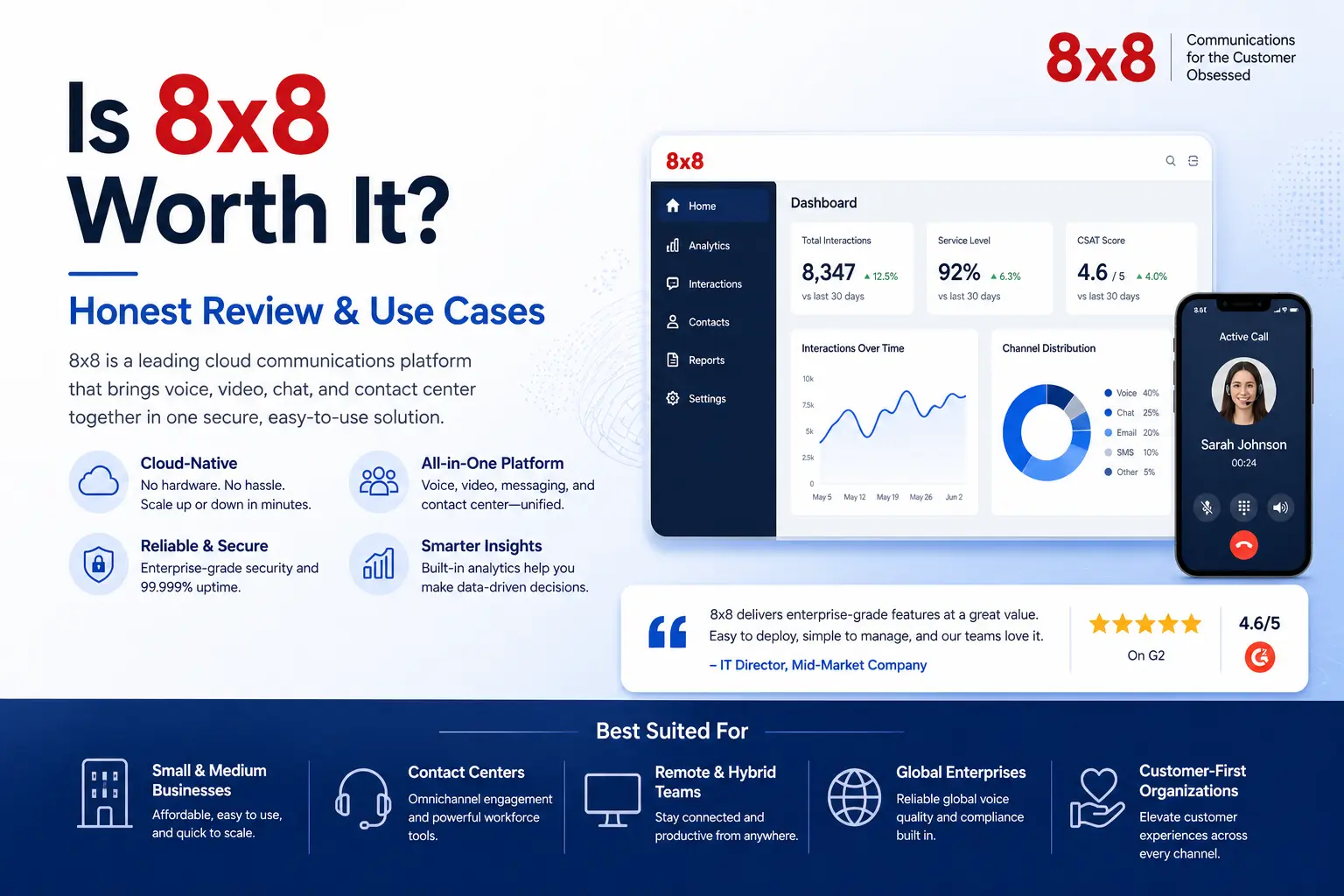
Is 8x8 Worth It? Honest Review, Pricing Breakdown & Real Use Cases (2026)
Choosing a business communication platform is the kind of decision that's easy to put off and expensive to get wrong. Your team relies on it every single day — calls, video meetings, customer support, internal chat — so if it doesn't hold up, you'll feel it fast, usually in the form of dropped calls during a client demo or a frustrated support queue.
So: is 8x8 actually good, or is it another VoIP platform riding on marketing copy? This review breaks down what 8x8 actually does, what it costs once you get past the quote-only pricing wall, where it genuinely wins, where it falls short, and who should — and shouldn't — consider it.
What Is 8x8?
8x8 is a cloud communications platform built around what the company calls XCaaS (Experience Communications as a Service) — a single system combining:
- Voice (VoIP calling), including domestic and international lines
- Video meetings, supporting up to 500 participants on higher tiers
- Team messaging with file sharing and persistent chat channels
- Contact center tools for support and sales teams, with routing, recording, and analytics
It's built for businesses that want one vendor handling phones, video, and customer support rather than stitching together three or four separate tools. That consolidation is 8x8's core pitch, and it genuinely lands for the right kind of company — more on exactly which kind below.
Key Features Worth Knowing About
All-in-one communication. Calls, chats, and meetings live in a single admin console and a single set of apps (desktop, mobile, browser), which removes a real source of friction compared to running separate phone and chat vendors.
HD voice and video quality. 8x8 backs this with one of the more aggressive uptime guarantees in the industry — a 99.999% SLA that's contractually tied to service credits, not just a marketing number. Call quality in practice is genuinely good, provided your internet connection holds up its end.
Advanced analytics. Supervisor-level reporting, call metrics, and customer interaction tracking become available starting at the contact-center tiers (X6 and above) — this isn't included at the entry level, which is a detail worth flagging since it's easy to assume otherwise.
CRM integrations. Native connections to Salesforce, HubSpot, Zendesk, and NetSuite show up from the X2/X4 tier onward, though deeper custom field syncing is typically professional-services work rather than a self-serve toggle.
Global calling. This is genuinely one of 8x8's strongest differentiators. The X2 plan includes unlimited calling to 14 countries; X4 and above extends that to 48+ countries. For businesses with international offices or clients, this single feature can outweigh a higher sticker price compared to competitors who charge per-minute for every international call.
8x8 Pros and Cons
Honest take: 8x8 is a genuinely capable system, but the value depends heavily on whether you actually need its strongest features — international calling and combined UC+CC — and whether you're prepared to negotiate, since the list price is rarely what anyone actually pays.
8x8 Pricing in 2026: What It Actually Costs
8x8 stopped publishing prices on its website in late 2023, so every current figure below comes from third-party buyer data (Vendr transaction benchmarks, G2/Capterra user reports, and reseller documentation) rather than 8x8's own site. Treat these as realistic ranges to budget around, not a guaranteed quote — your actual price will depend on seat count, contract length, and how much negotiating you do.
The practical takeaway: get the regulatory fees, toll-free rates, and any escalation clause written into your contract before signing, not after. Multi-year commitments commonly unlock 10–25% additional savings, and 8x8's pricing is genuinely negotiable — buyers with competitive quotes in hand routinely report meaningfully better terms than the first number offered.
Real Use Cases of 8x8
Small businesses. Affordable entry-level calling with professional call handling — auto-attendant, voicemail, and basic call routing — without needing on-premise hardware or an IT team to manage it.
Remote and hybrid teams. Full desktop and mobile apps mean your team can answer business calls and join meetings from anywhere, with the same number and presence whether they're in the office or not.
Customer support centers. This is where 8x8 genuinely shows its strength once you're on the X6+ tiers — intelligent call routing, recording, and real analytics give support leads visibility into queue performance and individual agent metrics.
Sales teams. Call tracking and CRM-linked logging help sales teams see which calls are converting and follow up systematically rather than relying on memory and sticky notes.
Who Should Use 8x8?
8x8 is a strong fit for:
- Startups and SMEs that want one platform instead of separate phone, video, and chat vendors
- Remote-first companies needing reliable mobile and desktop apps
- Customer support teams that will actually use the contact-center tier (X6+) features
- Agencies and businesses with international clients or offices, where 8x8's unlimited multi-country calling offers real, calculable savings over per-minute competitors
Who Should Avoid 8x8?
It's probably not the right fit if:
- Your internet connectivity is unreliable. 8x8 (like any VoIP platform) is only as good as the network underneath it.
- You only need basic domestic calling. Cheaper, simpler standalone VoIP tools exist if international calling and contact-center depth aren't priorities for you.
- You want transparent, self-serve pricing. If a published price list matters to you, 8x8's quote-only model will be a genuine source of friction during evaluation.
- You're under 10 seats. 8x8's negotiation leverage and per-seat economics tend to favor mid-size and larger deployments.
8x8 vs. Competitors: Quick Comparison
The honest read: if international calling and a combined UC+CC stack matter to you, 8x8 is genuinely competitive despite the higher headline price — the per-minute savings on global calls can outweigh the seat-price gap quickly. If you're a domestic-only small team, Nextiva or Zoom Phone will likely save you money without giving up much you'd actually use.
Is 8x8 Worth It? The Direct Answer
Final verdict: 8x8 earns its reputation as a solid, reliable platform — its uptime SLA is one of the few in the industry actually backed by contractual credits, and its international calling genuinely undercuts competitors who meter every cross-border minute. But it's not the easy, transparent buying experience smaller teams might want, and the value really only shows up once you're using the features that justify the price: multi-country calling, combined UC+CC, or compliance-heavy industries like healthcare and finance.
Expert Verdict
8x8 is a credible enterprise-grade communications platform that delivers real, measurable value — particularly for growing or international businesses that can use its strongest features. It's not the cheapest option, and it's not the easiest to buy. But measured against legacy on-premise phone systems, it's a substantial upgrade in flexibility, reliability, and scalability.
Conclusion
If you're still asking "is 8x8 good?" — the honest answer is: it depends on what you're solving for, but for most growing or international businesses, it's a genuinely solid investment. It offers real scalability, dependable uptime, and features that streamline communication as your team grows.
The caveat that matters most: budget for the fees that don't show up on the headline price, negotiate before you sign rather than after, and make sure your internet infrastructure can actually support it. Get those three things right, and 8x8 holds up well against the competition.