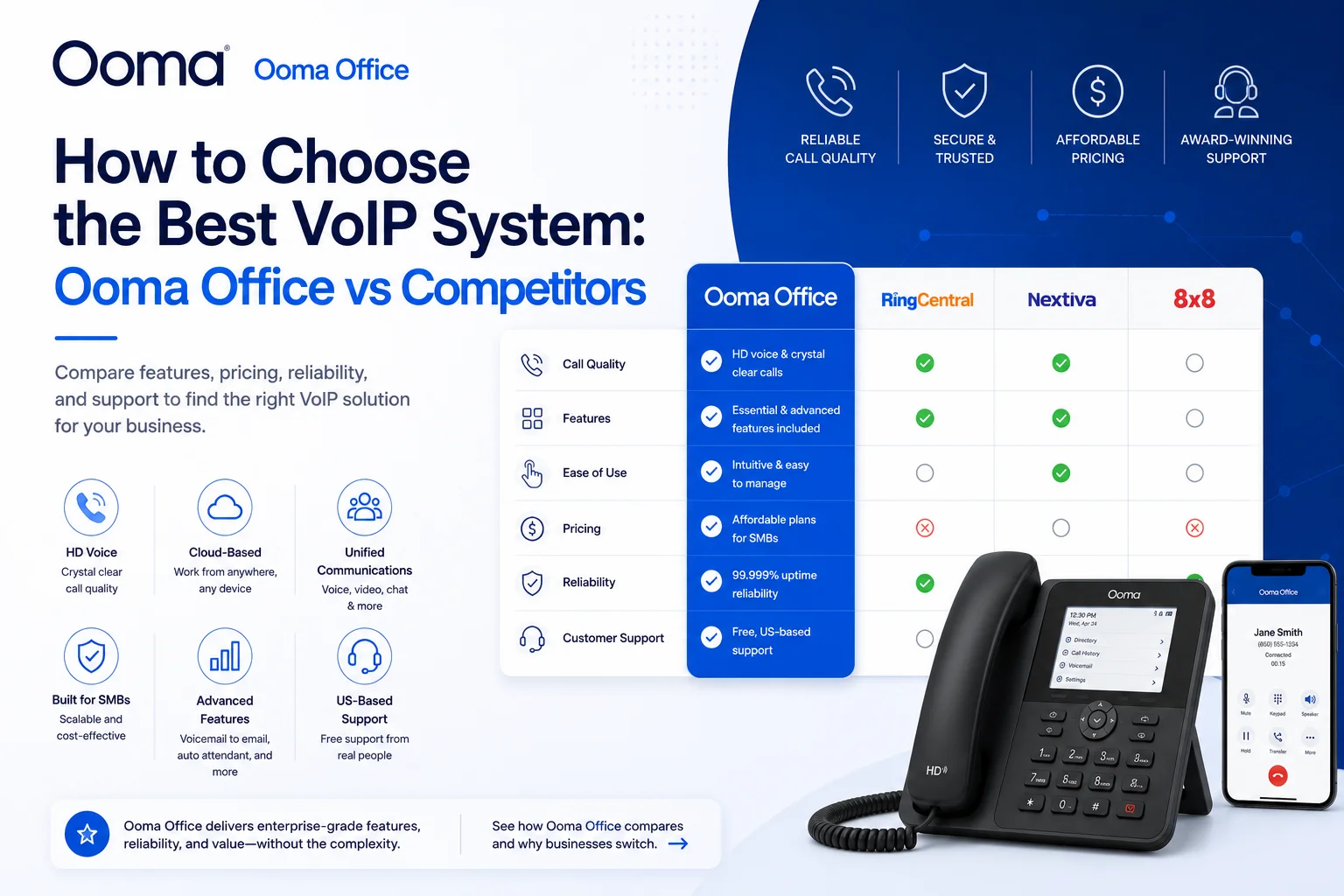
How to Choose the Best Business VoIP System: Ooma Office vs. RingCentral, Nextiva, Vonage & 8x8
Picking a business phone system is one of those decisions that looks simple until you actually start comparing quotes. Every provider advertises a low "starting at" price, and then the real cost shows up later — in required annual contracts, regulatory fees tacked onto the invoice, or features you assumed were included that turn out to require the next tier up.
This guide compares Ooma Office against four of its most common alternatives — RingCentral, Nextiva, Vonage, and 8x8 — on the things that actually matter: real pricing (not just the headline number), feature depth, scalability, and support. By the end, you'll know which one fits your business, not just which one has the flashiest homepage.
Key Factors to Weigh Before You Choose
Before comparing specific vendors, it helps to know what actually separates a good fit from a bad one:
- Real cost vs. advertised cost. Many providers require a 12-month commitment to hit their lowest advertised rate, and mandatory regulatory fees, additional phone numbers, and add-ons can push your actual bill 15–50% above the sticker price.
- What's actually included at the entry tier. Some platforms bundle unlimited calling, faxing, and an auto-attendant into their cheapest plan; others treat those as upgrades.
- Video and messaging limits. Participant caps and SMS allowances vary widely, and some providers cap texting per account rather than per user — a detail that matters a lot once your team grows past a handful of people.
- Integration depth. If your team lives in a CRM, check whether integrations are native, add-on, or simply unavailable at your price tier.
- Reliability and support quality. Advertised uptime SLAs (99.9% vs. 99.999%) matter less than real-world support responsiveness — check recent reviews, not just the marketing page.
Ooma Office Overview
Ooma Office is a cloud-based business phone system built around simplicity and low upfront cost, popular with small businesses transitioning off a traditional landline. Setup is largely plug-and-play, phones ship preconfigured, and there's no requirement to sign an annual contract at any tier.
Each plan includes one phone number per user and unlimited calling across the US, Canada, Mexico, and Puerto Rico. Additional local phone numbers run $9.99/month each ($14.95 for Canadian numbers). Note that Ooma's month-to-month pricing is genuinely flat — there's no annual-discount version of these numbers, which is unusual among competitors that typically show a lower "annual" rate and a higher "monthly" rate for the same plan.
Core Features of Ooma Office
- Calling and receptionist: Multi-level virtual receptionist, call parking, transfer, and call flipping between devices, included even on Essentials
- Mobile and desktop apps: iOS and Android on every tier; desktop softphone calling specifically requires Pro or above
- Voicemail and fax: Both analog and digital fax support standard — a genuine rarity in VoIP, where fax is usually a separate add-on entirely
- Video conferencing: Up to 25 participants on Pro, up to 100 on Pro Plus; not included on Essentials
- Call recording and analytics: Pro and above
- CRM integrations: Limited to Pro Plus and Enterprise; lower tiers have essentially none
Pros and Cons of Ooma Office
Pros: Genuinely affordable for small teams, with more included at the entry tier than most competitors offer at that price. No long-term contract on any self-serve plan. DIY setup that most businesses complete in under 20 minutes.
Cons: Support quality gets mixed reviews — responsive for some, frustratingly slow for others, based on recent user feedback across review platforms. SMS caps are shared across the whole account, not per user, which becomes a real constraint above roughly 15 seats. CRM integrations and call-center features are gated behind higher tiers or a custom Enterprise quote.
How Ooma Compares to the Competition
RingCentral is the heavier-duty platform — better suited to teams that need deep integrations, larger video meetings, and a broader unified-communications feature set. Ooma wins on simplicity, transparent flat pricing, and the fact that its entry tier already includes things RingCentral often gates behind an upgrade. If you're doing a straightforward landline-to-VoIP switch with basic needs, Ooma is enough. If you need a full UCaaS platform with heavy third-party tooling, RingCentral is the stronger fit.
Nextiva's advertised entry price is lower than Ooma's, but that rate typically requires an annual commitment — Ooma's flat month-to-month price is directly comparable without that trade-off. Nextiva pulls ahead for businesses planning to scale, with more advanced call analytics, automation, and volume discounts built in as you add seats. For a very small team or a startup that wants predictable, contract-free pricing, Ooma remains the simpler choice — its entry tier bundles things like faxing and a full auto-attendant that Nextiva may require an upgrade for.
Vonage's promotional annual pricing can undercut Ooma at the entry level, but it comes with a real trade-off: a required 12-month contract and early termination fees if you cancel before the term ends. Ooma's flat, contract-free pricing is easier to budget against, especially for a business that isn't ready to commit long-term. Vonage's edge shows up in its developer-facing API platform and broader out-of-the-box collaboration tools on higher tiers — genuinely useful if you have technical resources to build custom workflows, less so if you just need reliable calling.
Worth flagging clearly: 8x8 no longer publishes standard pricing on its website — every quote now goes through a sales conversation, and third-party pricing trackers report meaningful variation depending on deployment size and negotiated discounts. If international calling coverage or built-in contact-center tooling is a priority, 8x8 is worth a quote. If pricing transparency and flat, predictable costs matter more, Ooma's published, unchanging rate is the more budget-friendly starting point for comparison shopping.
How to Decide Which VoIP System Is Best for Your Business
- List your must-haves. Unlimited international calling? Native CRM integration? A specific number of seats? Write it down before you start comparing quotes.
- Match features against your list. Ooma covers calling basics extremely well but is lighter on analytics and integrations. RingCentral and Nextiva go deeper on both, at a higher realistic cost.
- Budget for the real price, not the headline price. Factor in mandatory fees, additional phone numbers, hardware, and whether the advertised rate requires an annual contract. A provider that looks $5/user cheaper on the homepage can end up more expensive once regulatory fees and add-ons are included — 8x8 and Vonage both illustrate this clearly.
- Weigh contract flexibility against long-term savings. If you can commit to 12 months, annual pricing from Nextiva or Vonage may beat Ooma's flat rate. If you want the freedom to cancel anytime, Ooma's no-contract model has real value beyond just the sticker price.
- Test before you commit. Use whatever trial period is available to check call quality and the admin interface firsthand — trial availability and terms vary and change often, so confirm current details directly with each vendor rather than assuming.
- Plan the migration. Number porting, hardware provisioning, and user training all need a plan — most providers port existing numbers at no charge, but confirm this before switching.
The Bottom Line
Ooma Office is the right call for small businesses that want a genuinely simple, no-contract phone system with more bundled into the entry tier than most competitors offer at a similar price. Where it falls short — CRM integrations, contact-center tooling, per-user texting limits — is exactly where RingCentral, Nextiva, and 8x8 pull ahead, at a real cost premium that usually comes with an annual commitment.
There's no universal "best" here. The right choice depends on whether you're optimizing for the lowest predictable monthly cost (Ooma), the deepest feature set (RingCentral), analytics and growth-readiness (Nextiva), international reach and developer flexibility (Vonage), or contact-center-native tooling (8x8). Match the provider to your actual requirements list, not the other way around.