How Much Does RingCentral Cost Per User? Complete 2026 Pricing Breakdown
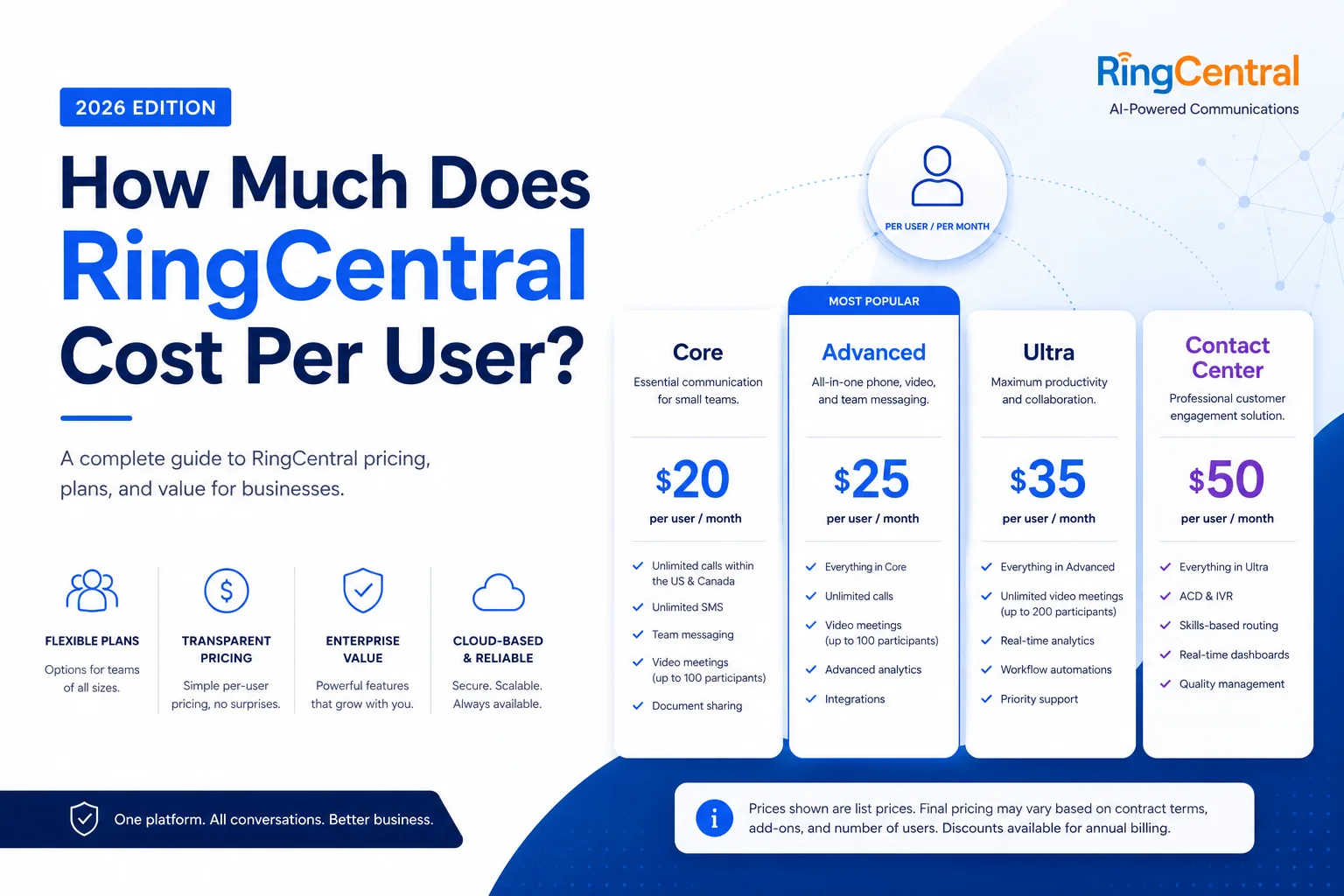
RingCentral's advertised pricing looks simple: three plans, $20 to $35 per user per month. But the number on the pricing page rarely matches what ends up on your invoice. Add-ons, SMS caps, regulatory fees, and AI tools can push your actual per-user cost 50–125% above the headline rate.
This guide cuts through the noise. You'll find the real per-user cost for every RingCentral plan, a straight answer on annual vs. monthly billing savings, a full breakdown of add-on fees most buyers miss, and real-world billing examples for different team sizes.
RingCentral Plans at a Glance: What Each Tier Actually Costs
RingCentral's business phone product, RingEX, comes in three tiers — Core, Advanced, and Ultra — with prices ranging from $20 to $45 per user per month depending on billing frequency.
Here's the full picture:
All three plans include unlimited domestic calling within the US and Canada, team messaging, video meetings, and 24/7 support. The differences lie in what gets gated.
Breaking Down Each Plan — What You're Really Getting
Core — $20/user/month (Annual)
The Core plan delivers clean voice calling, an auto-attendant, basic call queues, video meetings for up to 100 participants, and AI noise cancellation. It also includes voicemail-to-text and app-based calling across desktop and mobile.
What it doesn't include is where things get tricky. Core is the plan most teams should skip if they text customers — 25 SMS messages per user per month is roughly one a day, which a single appointment-confirmation workflow burns through by Tuesday. Call recording on Core is on-demand only, and Salesforce integration requires an upgrade to Advanced.
Bottom line: Core works for small internal teams with straightforward call needs. If you text customers at all, you'll outgrow it fast.
Advanced — $25/user/month (Annual)
Five extra dollars per user buys the recording and CRM coupling that Core leaves out — which together are worth more than $5 of operational headache.
The Advanced plan adds automatic call recording, advanced call monitoring with whisper and barge capabilities, and CRM integrations with HubSpot, Salesforce, and Zendesk. SMS allowance rises to 100 messages per user per month, and you also get multi-site administration and more detailed analytics dashboards.
Advanced is the sweet spot for most businesses — it unlocks CRM integrations, automatic recording, and supervisor controls without breaking the bank.
Bottom line: For any team with a sales or support function, Advanced is the practical default. The $5 jump from Core pays for itself quickly.
Ultra — $35/user/month (Annual)
The Ultra tier raises SMS to 200 per user and toll-free minutes to 10,000 pooled. Storage becomes unlimited. Video meetings expand to 200 participants. You also get device-level analytics, which IT teams managing hundreds of headsets and desk phones actually use.
One important caveat: the "unlimited" storage doesn't include video meetings, and all files are subject to time-based deletion policies — call recordings are deleted after 90 days.
Ultra only makes sense for very large teams — 100+ users — that want to monitor customer service metrics in detail. For most mid-sized businesses, Advanced strikes the better balance of cost and functionality.
Bottom line: Don't pay for Ultra unless you genuinely need the storage, device analytics, or expanded toll-free pool.
Customer Engagement Bundle
The Customer Engagement Bundle combines RingEX Ultra with two boosters: Business SMS Booster (shared inbox, compliance features, templates) and Call Queues Booster (smarter routing, callbacks, real-time insights). Pricing requires contacting sales.
Annual vs. Monthly Billing: How Much Do You Actually Save?
Annual billing commitment is required for the advertised prices. Month-to-month pricing runs $10 per user per month higher across all tiers — a 22–33% premium for flexibility depending on the plan tier: 33% for Core, 29% for Advanced, and 22% for Ultra.
For a 50-person team on the Advanced plan:
- Annual billing: 50 × $25 = $1,250/month
- Monthly billing: 50 × $35 = $1,750/month
- Annual savings: $6,000/year
The math is clear for teams with stable headcount. The trade-off is contract flexibility — annual contracts auto-renew, typically with a 1–3 year minimum commitment, and you must cancel before the renewal date to avoid being locked in for another term.
Practical tip: If you're still evaluating headcount, start month-to-month for 60–90 days, then switch to annual once you have a stable user count.
Add-Ons and Hidden Fees: Where Your Bill Actually Grows
This is the section most buyers skip — and then regret. Mandatory regulatory fees and common add-ons push actual costs 50–125% higher than advertised rates.
Phone Numbers
Each additional local or toll-free number costs $4.99/month. International toll-free numbers run $14.99/user/month plus a $25 one-time fee. Vanity numbers carry a $30 one-time setup fee plus $4.99/month.
AI & Automation Tools
RingCentral AI Receptionist starts at $39 per month as an add-on across all plans. It handles call routing, appointment booking, and lead capture — but without it, you manage those workflows manually.
RingSense AI Conversation Intelligence — which provides advanced call analytics, coaching, and performance analysis — is an additional $60/user/month.
SMS & Messaging
For higher SMS volumes beyond each plan's cap, you need the Business SMS Booster add-on at $25 per month, or pay per message through High Volume SMS. The per-message overage rate is $0.0085.
Contact Center
RingCX AI Contact Center starts at $65/user/month billed annually. RingCentral Contact Center Enterprise — with proactive outreach, sales dialers, and an Interactive Voice Agent — is priced on request only.
Conference Rooms
A RingCentral Rooms license costs $49/room/month or $468 annually — a 20% saving on the monthly rate.
Regulatory Fees
Every RingCentral invoice includes government pass-through charges: FCC regulatory fees, E911 service fees, and per-call surcharges for 411 and inbound payphone calls. These fees — along with add-on costs — typically push the real bill 15–30% higher than the base plan cost.
Real-World Cost Examples
Example 1: Small Business (10 Users, Advanced Plan)
This is a real-world enterprise scenario. Once you cross 50–100 seats, volume discounts of 10–20% off list price are common, especially on multi-year contracts. At this scale, always negotiate.
How RingCentral Pricing Compares to Alternatives
RingCentral is not the cheapest UCaaS option, but it's not the most expensive either. Here's a quick orientation:
RingCentral's published list pricing often falls below list rates for organizations with 50+ users, multi-year commitments, or competitive leverage — so the comparison table above is best read as a starting point, not a final number.
The honest takeaway: RingCentral costs more than Zoom Phone but delivers a substantially deeper feature set. If your team lives in video calls and doesn't need advanced call routing, Zoom Phone wins on price. If you need serious PBX capabilities, CRM integrations, and compliance certifications, RingCentral's premium is usually justified.
How to Keep Your RingCentral Bill Under Control
A few practical tactics that buyers often miss:
- Start on Core, upgrade selectively. Many teams discover Core handles 80% of their needs. Upgrade individual users to Advanced only when the CRM integration or call recording is actually needed.
- Negotiate at 50+ users. List price is the starting point. Volume discounts of 10–20% are common for multi-year contracts at this scale.
- Watch your SMS usage before buying the booster. Track actual message volume for 30 days before committing to the $25/month SMS Booster add-on.
- Audit add-on licenses quarterly. AI Receptionist and RingSense seats add up fast. Remove licenses for users who aren't actively using the features.
- Use the 14-day free trial strategically. Test call quality, the admin portal, and your specific integrations before committing to an annual contract.
Conclusion: What RingCentral Actually Costs Per User
The short answer: budget $20–$35 per user per month for the base plan on annual billing, then add 15–30% for regulatory fees and any essential add-ons. For most growing businesses, the Advanced plan at $25/user is the right starting point — it unlocks call recording and CRM integrations that Core withholds, without the storage-focused extras of Ultra that most teams don't need yet.
Before signing anything, get an itemized quote that includes taxes, regulatory fees, and any add-ons your team actually needs. The difference between the advertised rate and the real invoice is where most buyers get surprised.