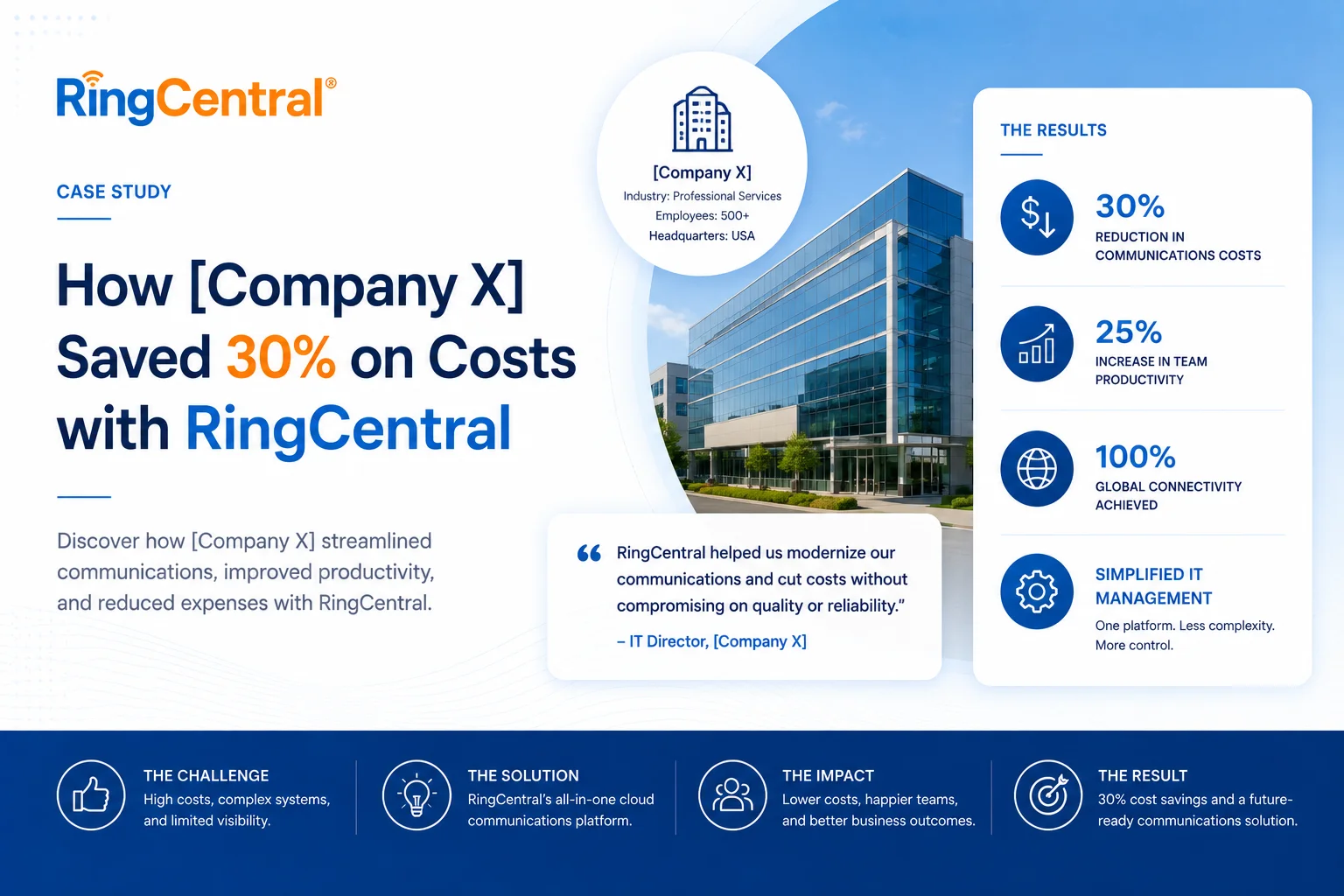
Case Study: How First Bank Cut Phone System Costs by 30% with RingCentral
First Bank isn't a scrappy startup looking to save a few hundred dollars a month. It's a multibillion-dollar financial institution with more than 100 branches, over a thousand employees, and a dozen-plus call centers — the kind of organization where a phone system decision touches nearly every part of the business. When its CIO says the switch to RingCentral cut phone costs by 30%, that number carries some real weight behind it.
Here's how that happened, what it took to get there, and what other organizations can actually take from it.
The Problem: A Phone System Older Than Some of the Staff Using It
Before the migration, First Bank ran its communications on a traditional on-premises PBX spread across its branch network, backed by six or seven dedicated servers just to keep the call center infrastructure running. That setup gets expensive in ways that don't show up on a single line item: aging hardware needs regular maintenance, on-site trips to fix problems, and eventual replacement cycles that come due whether the budget's ready or not.
"As those PBX systems got older, they were becoming more expensive to maintain and upgrade," said Bala Nibhanupudi, First Bank's Chief Information Officer. Beyond the direct costs, the old system also boxed in how employees could work — sales staff couldn't take business calls once they left the building, and IT spent real time on manual, location-by-location updates instead of strategic work.
Why First Bank Chose RingCentral
First Bank didn't rush the decision. The team spent roughly six months evaluating the major UCaaS providers on the market before settling on RingCentral, and the deciding factor wasn't price — it was breadth. Other vendors covered pieces of what First Bank needed; RingCentral covered the whole stack on one platform.
Nibhanupudi pointed to this directly: RingCentral offered not just softphone calling across desk phones, computers, and mobile devices, but a full set of workforce optimization tools — quality management, speech analytics, and unified messaging — bundled into a single system rather than stitched together from multiple vendors. For an organization managing a dozen-plus call centers, having quality management and analytics built into the core platform rather than bolted on separately was a meaningful differentiator.
The availability of RingCentral's Professional Services team for a rollout this size was the other deciding factor — a deployment across 100+ branches isn't something most IT teams want to run entirely on their own.
Rolling It Out Across 100+ Branches
RingCentral's Professional Services team worked on-site with First Bank throughout the first phase of deployment — handling number porting, on-location setup, coordination with the bank's other vendors, and hands-on staff training rather than leaving the bank to figure out the new system alone. First Bank split the rollout into two phases rather than attempting a single company-wide cutover, which let the team measure real results after phase one and adjust before expanding further — a meaningfully lower-risk approach than an all-at-once migration across more than a thousand employees.
The Result: 30% Lower Phone System Costs
By retiring the legacy PBX and its six-to-seven supporting servers in favor of RingCentral's cloud platform, First Bank cut its overall phone system costs by roughly 30% — and that figure already accounts for the cost of the new RingCentral desktop VoIP phones deployed across the organization. In Nibhanupudi's words: even after factoring in the new hardware, the RingCentral rollout was already delivering 30% savings on total phone system costs during just the first phase of the rollout.
A few things drove that number:
- Hardware and maintenance disappeared. No more on-site PBX equipment, no more dedicated servers to patch and eventually replace, no more truck rolls to fix a broken phone at a branch. (A separate RingCentral customer, Ryder Systems, put a number on what that used to cost them: roughly $400 every time they had to dispatch a technician to fix a phone on-site — an expense that simply stopped once they moved to the cloud.)
- The cost model flipped from capital to subscription. Instead of large, irregular hardware investments, First Bank moved to predictable monthly per-user pricing — easier to budget against and without the surprise of a sudden upgrade bill.
- Collaboration tools came bundled in. Messaging, video conferencing, and contact center capability arrived as part of the same platform rather than as separate systems needing separate contracts and separate IT support.
Beyond the Cost Savings
The financial number is the headline, but the operational changes mattered just as much day to day:
Reliability improved. Cloud infrastructure handles redundancy and failover automatically, removing a lot of the outage risk that comes with aging on-premises hardware — the kind of downtime that costs a bank real productivity every time a branch phone line goes dark.
Staff gained real mobility. Employees could make and receive calls on their business number through the RingCentral mobile app from anywhere, not just from a desk phone — a meaningful shift for sales and relationship staff who previously had no way to take business calls once they left the branch.
Call routing got smarter. Built-in IVR and auto-attendant functionality routes callers to the right person faster, cutting down on the frustration of being bounced around — some RingCentral customers in similar deployments have reported hold time reductions in the range of 90%+ after implementing better routing.
Scaling stopped requiring hardware projects. Adding a new branch or expanding capacity is now a matter of adjusting a subscription rather than provisioning new physical infrastructure — a meaningful advantage for an organization that grows by opening new locations.
First Bank's Results Aren't an Outlier
Looking at other audited RingCentral deployments puts First Bank's 30% in useful context rather than treating it as a one-off:
- Aim Bank, a similarly sized financial institution, replaced a legacy multi-carrier PBX across 27 branches and realized a 173% ROI, recovering its investment within the first five months — verified by an independent Nucleus Research audit.
- Healthcare Claims Management, a revenue cycle management company handling roughly 19,000 monthly inbound calls, saw a 441% ROI after deploying RingCentral's contact center and business phone platform, recovering its investment in just 2.4 months and cutting its cost per call from $14.50 to $9 — also independently audited by Nucleus Research.
Different industries, different scales, but the same underlying pattern: retiring legacy on-premises telecom infrastructure in favor of a cloud platform tends to pay for itself fast, not eventually.
What Other Organizations Can Take From This
If First Bank's results are the kind of outcome you're hoping to replicate, a few things from their process are worth borrowing directly:
- Audit what you actually have before you migrate. First Bank's team knew precisely what they were replacing — down to the exact server count — which made measuring the savings afterward straightforward rather than a guess.
- Prioritize platform breadth over point solutions. A single platform covering voice, video, messaging, and contact center avoids the hidden costs of stitching together separate vendors later.
- Use professional implementation support for large rollouts. Number porting, on-site setup, and staff training are exactly the areas where an experienced implementation team prevents costly delays.
- Roll out in phases. Measuring results after an initial phase — rather than committing the whole organization at once — gives you room to refine before scaling further.
- Budget for network readiness. Cloud voice and video need adequate bandwidth; this cost is typically far smaller than what you'd spend keeping legacy PBX lines running.
- Invest in training from day one. The faster staff adopt softphones, mobile calling, and messaging features, the faster the financial and productivity benefits actually show up.
The Bottom Line
First Bank's migration is a useful reminder that a phone system upgrade isn't just a technology refresh — it's a cost-reduction lever with a fast payback when the legacy alternative is aging on-premises hardware. Retiring a PBX and a rack of servers in favor of a single cloud platform cut First Bank's phone costs by 30%, while also solving problems — mobility, reliability, scalability — that the old system was never going to fix regardless of budget.