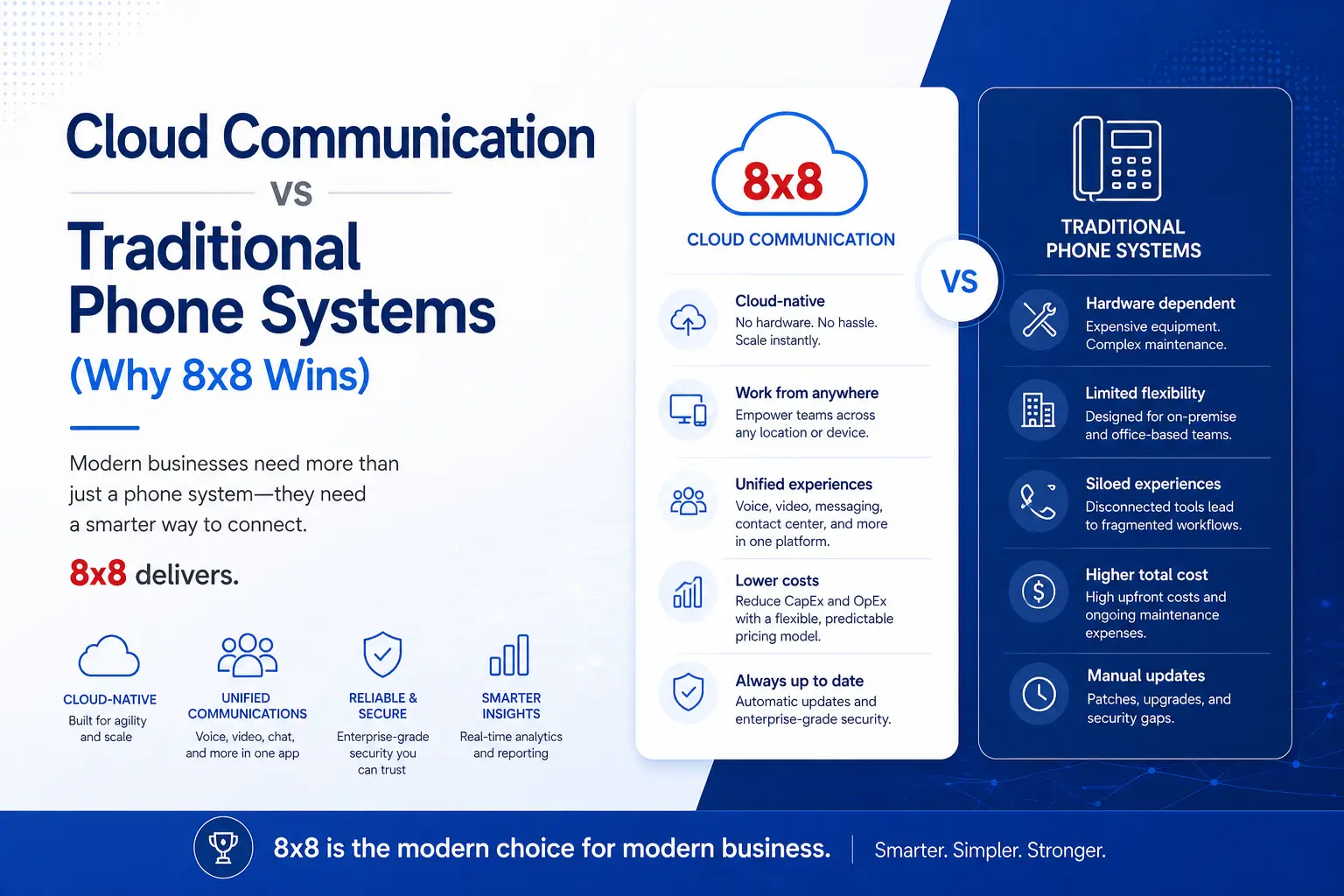
Cloud Communication vs. Traditional Phone Systems: Why More Businesses Are Choosing VoIP (and 8x8)
Your phone system is doing more than handling calls—it's shaping how fast your team responds, whether remote agents can work effectively, and how much you spend keeping everything running. For businesses still operating on legacy PBX hardware, that last number is often much higher than it needs to be.
The shift from traditional phone systems to cloud-based VoIP is accelerating. The global cloud PBX market is projected to reach $26.8 billion in 2026, and over 75% of US organizations plan to fully transition off legacy telephony by year end. If you're still weighing the options, this guide gives you the full picture—honest cost data, a clear feature comparison, and a realistic look at when each system actually makes sense.
What Is a Traditional PBX Phone System?
PBX stands for Private Branch Exchange—essentially, a hardware switchboard installed on-site that manages internal extensions and routes external calls. It's the system that's been running business phones for decades.
Traditional PBX uses copper phone lines and physical infrastructure. Every handset, every extension, every routing rule lives in a box in your server room or telecom closet. When it works, it's reliable. When something breaks, you call a technician.
The core characteristics of on-premise PBX:
- Installed hardware on-site (switches, line cards, physical wiring)
- Managed internally or through a dedicated maintenance contract
- Calls travel over the public switched telephone network (PSTN)
- Adding users requires physical installation and sometimes new hardware modules
- Upfront capital costs before a single call is made
For the right environment—typically a single physical location with a stable, experienced IT team and no immediate need to scale—PBX is defensible. For most modern businesses, it's a legacy cost center.
What Is Cloud Communication (VoIP)?
VoIP (Voice over Internet Protocol) converts your voice into digital data packets and transmits them over your internet connection, bypassing copper phone lines entirely. Cloud communication builds on VoIP technology by hosting the entire phone system—routing, voicemail, auto-attendants, queues, analytics—in remote data centers managed by your provider.
The practical result: your team can make and receive calls from a laptop, mobile app, or desk phone from anywhere with a decent internet connection. There's no server room, no maintenance contract, and no technician visit when you need to add a new user.
Platforms like 8x8 take this further by combining voice calls, video meetings, team messaging, SMS, and contact center features into a single cloud-based system—what's often called UCaaS (Unified Communications as a Service) or XCaaS (Experience Communications as a Service).
Cloud VoIP vs. Traditional PBX: The Full Comparison
The cost difference is the most striking part for most businesses. On-premise PBX installation can run $1,000 to $25,000+ before a single call is made, with ongoing maintenance contracts adding $500–$750 per month. Cloud VoIP charges a predictable per-user monthly fee—typically $15–$55 per user—with maintenance handled entirely by the provider.
Businesses switching from legacy phone systems to cloud VoIP typically save 40–60% on total telephony costs over the first two years.
Why 8x8 Specifically Stands Out Among VoIP Providers
Moving to cloud VoIP is the right decision for most businesses. Choosing 8x8 over other providers is a separate question—and worth a direct answer.
Everything in One Platform
Most businesses cobbling together a phone system end up with separate tools for calls, video meetings, internal messaging, and contact center operations. Each has its own login, its own billing, its own support team when something breaks.
8x8 consolidates voice, video, team messaging, SMS, and contact center management under one platform and one dashboard. For managers, that means one system to monitor. For agents, one interface to learn. For IT, one vendor to deal with.
Enterprise Features Without Enterprise Barriers
Small and mid-sized businesses have historically been locked out of the tools that large enterprises use—real-time analytics, AI-powered routing, quality management, workforce forecasting. 8x8 makes these available starting from their contact center tiers, without requiring a six-figure infrastructure investment.
Global Calling Without the Complexity
8x8's higher-tier plans include unlimited calling to up to 48 countries—a significantly wider coverage area than most competitors. For companies with international customers or distributed teams across multiple countries, this is a meaningful operational advantage over setting up local numbers or paying per-minute international rates.
AI Tools That Actually Help Agents
Beyond IVR menus, 8x8 has invested in practical AI features: Agent Assist surfaces relevant knowledge base articles during live calls, predictive dialers eliminate time wasted on manual outbound dialing, and workforce management algorithms forecast staffing needs across channels automatically. These aren't theoretical future features—they're available in current plans.
The Real Cost Comparison: PBX vs. 8x8
⚠️ Estimates based on reported averages. Actual costs vary by team size, features, and contract terms. Always request a custom quote. </div> </div>
These numbers are illustrative, not a firm quote—but they reflect real benchmarks from publicly available research. The directional point holds: cloud VoIP dramatically reduces both upfront capital and ongoing operational costs, particularly in the first two years when legacy systems are most expensive.
Side-by-Side Scenario: The Same Business on PBX vs. 8x8
Sometimes the clearest way to understand a technology decision is to see it play out in practice.
Scenario: A 25-person marketing agency opens a second office and needs to onboard 10 new support agents.
When PBX Still Makes Sense
It wouldn't be honest to declare cloud VoIP the winner for every business without qualification.
There are scenarios where keeping—or choosing—an on-premise PBX is defensible:
- Your entire team operates from one physical location with no remote work, ever
- You operate in an industry with strict data sovereignty requirements that cloud hosting can't satisfy
- You've recently invested heavily in PBX hardware and the depreciation math doesn't support early replacement
- Your internet infrastructure is genuinely unreliable (though this is increasingly rare)
For most businesses reading this in 2026, none of those conditions apply. But if they do, they're worth taking seriously.
When to Choose Cloud VoIP Like 8x8
Cloud communication is the stronger choice if you:
- Have remote, hybrid, or distributed teams
- Need to scale headcount quickly in either direction
- Want real-time analytics without a separate reporting tool
- Rely on CRM platforms like Salesforce, HubSpot, or Zendesk
- Serve customers across multiple channels (voice, chat, email, SMS)
- Operate across multiple countries or time zones
If you're running or building a contact center specifically, 8x8's contact center plans also add outbound dialing, IVR, workforce management, and AI-assisted agent tools—capabilities that simply don't exist in traditional PBX infrastructure.
Clearing Up the Common VoIP Myths
A few objections come up repeatedly when businesses consider switching. They're worth addressing directly.
"VoIP call quality is worse than traditional phone lines." This was true in the early 2000s when internet speeds were inconsistent. Today, with broadband connections running 100+ Mbps in most offices, VoIP call quality matches or exceeds traditional PSTN. The caveat is bandwidth: VoIP quality depends on your internet connection. A 25+ Mbps connection handles most business call volumes comfortably.
"VoIP is unreliable—what happens when the internet goes down?" Enterprise-grade VoIP providers like 8x8 maintain redundant data centers and SLAs guaranteeing high uptime. When internet does go down locally, agents can switch to mobile apps on cellular data with no interruption. Compare that to a PBX hardware failure, which grounds your entire operation until a technician arrives.
"Switching is complicated and disruptive." Most cloud VoIP deployments go live in days, not weeks. Number porting from your existing provider typically takes 1–4 weeks but doesn't require downtime during transition.
Pre-Switch Checklist: What to Verify Before You Migrate
The Bottom Line
The question isn't really "cloud vs. PBX" anymore—it's how quickly your business can capture the operational and cost advantages of moving to cloud communication.
Traditional PBX made sense when offices were static, teams were always on-site, and internet infrastructure was inconsistent. In 2026, none of those assumptions hold for most businesses.
Cloud VoIP platforms like 8x8 give you enterprise-grade communication tools—omnichannel support, real-time analytics, AI assistance, CRM integration—at a predictable monthly cost, without the capital expense or maintenance overhead that made legacy systems so burdensome. For businesses scaling quickly, managing remote or hybrid teams, or simply trying to reduce operational complexity, the case for switching is straightforward.
If you're evaluating 8x8 specifically, start by mapping your actual feature requirements to the available plans—and get a custom quote rather than relying on list pricing.