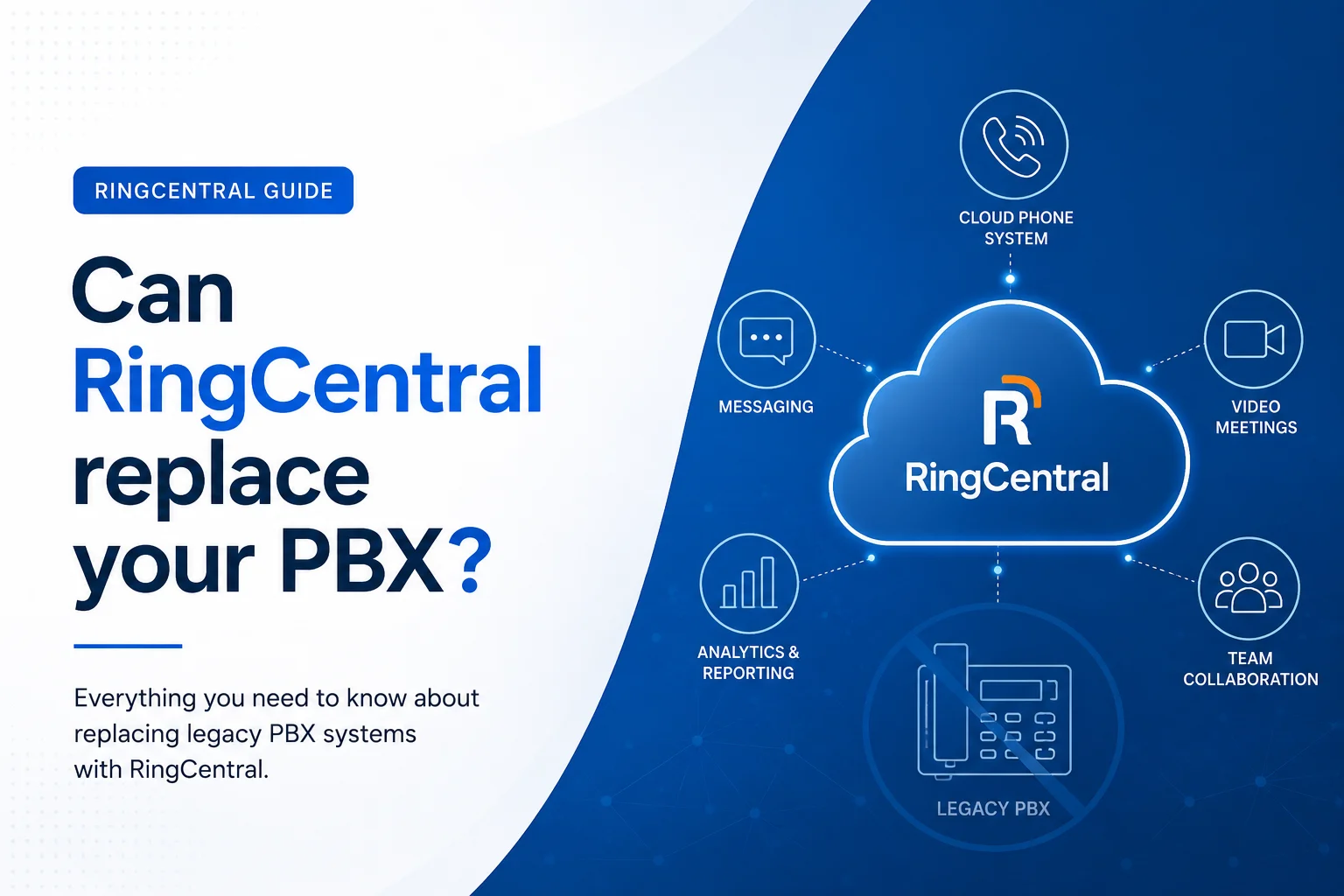
Can RingCentral Replace Your PBX? An Honest 2026 Migration Guide
Your legacy PBX is aging. Maintenance contracts are climbing. Remote work has exposed its mobility limits. And somewhere in the back of your mind, you're wondering whether it's finally time to move on.
The direct answer: yes, RingCentral can replace your on-premises PBX — completely. Cloud PBX eliminates the need for expensive on-premises hardware while delivering enterprise-grade call routing, management, and collaboration features. But "can it replace your PBX" and "should you replace your PBX right now" are different questions. The first is about feature coverage. The second is about planning, network readiness, migration complexity, and honest cost comparison.
This guide covers both.
What a PBX Actually Does — and What Cloud Changes
A PBX (Private Branch Exchange) is the system that manages internal phone extensions and routes external calls. Traditionally, it meant a server room, physical wiring, and a telecom technician for anything beyond basic changes. Setting up an on-premises PBX is a complicated and drawn-out process requiring the installation of specialized hardware.
A cloud PBX — what RingCentral calls RingEX — moves all of that processing into remote data centers. A hosted PBX provider takes care of all the technical aspects of telephony, receiving and processing call requests as they arrive. Using powerful cloud processing, it can rapidly and consistently manage call flow, resulting in high-quality private audio with negligible lag and minimal dropped-call rates.
The practical difference: RingCentral's cloud PBX solution combines unlimited VoIP calling, SMS/MMS messaging, internet fax, and HD video conferencing in a single platform. Set up takes less than 24 hours, with no complex installations or maintenance requirements. Your team can make and receive calls from any device — desk phones, smartphones, or computers — while you maintain complete control through an intuitive online dashboard.
A traditional PBX requires physical equipment to connect your phones to the PSTN (Public Switched Telephone Network). The servers and hardwired handsets must be installed on your premises by an engineer. As you can imagine, there's a high cost attached to this — and then there's the ongoing maintenance to consider. It's also much harder to scale an on-premises setup because you'd have to go through all that again for each new location.
What RingCentral Covers: Every Core PBX Feature, in the Cloud
The question most IT managers ask first is whether RingCentral can replicate every feature their current PBX provides. For standard telephony, the answer is yes — and the configuration happens through a web portal rather than hardware rewiring.
Auto-Attendant and IVR
RingCentral provides a configurable auto-attendant that greets callers and routes them through menu choices. Admins use an IVR editor to build call trees — "Press 1 for Sales, 2 for Support" — with multi-level menus, time-of-day routing, and holiday schedules. Changes take minutes online rather than requiring a technician visit.
Call Routing, Queues, and Ring Groups
Incoming calls route by extension, department, or skill. Ring groups let multiple users ring simultaneously. Hunt groups ring sequentially. Call queues hold callers for the next available agent with custom hold music and queue position announcements. Overflow rules direct calls when queues are full or after hours.
Voicemail With Transcription
Every extension gets voicemail with a custom greeting. RingCentral goes further by transcribing voicemail messages into text and delivering them by email or app notification — so staff can read messages at a glance without dialing in.
Call Recording
Automatic call recording is available on Advanced and Ultra plans. Recordings store in the cloud for playback and download, with access controls that restrict who can listen to which recordings.
Hold Music and Announcements
On-hold audio supports custom music files or recorded messages. Callers in a queue can hear branded content — promotions, service updates, or background music — rather than silence.
Call Forwarding, Delegation, and Screening
Calls can be forwarded to any number or group. Delegation allows assistants to answer on behalf of executives. Call screening lets users see who's calling before answering and apply rules — block, forward to voicemail, or screen by caller ID.
Paging and Intercom
Company-wide or group announcements can be broadcast via one-way paging from a desk phone or app. Intercom enables direct device-to-device communication for internal announcements.
Conference Calling
Built-in conferencing handles calls from small teams to hundreds of participants, with no separate bridge or dial-in number required.
Multi-Site Dialing
Extensions across multiple offices dial each other for free over RingCentral's network. To callers, it feels like one unified system — regardless of whether users are in different cities or countries.
Beyond PBX: What RingCentral Adds That Legacy Systems Never Had
In addition to everything an old-fashioned PBX supports — including voicemail, extensions, conferencing, paging, intercom calling, and toll-free numbers — a hosted PBX phone system can deliver complete mobile integration, business SMS, video calls and online meetings, and so much more.
Specifically with RingCentral:
Business SMS/MMS: Every user gets a business text number. Customer-facing teams use it for appointment confirmations, follow-ups, and support — on the same office number used for voice calls.
Team Messaging: Persistent group chat channels, direct messages, and file sharing — integrated with calling so users can escalate a chat to a call to a video meeting without switching apps.
HD Video Meetings: Built-in video conferencing with screen sharing, whiteboards, and AI meeting summaries. No separate Zoom account needed.
Internet Fax: Send and receive faxes digitally through the RingCentral app. No fax machine, no dedicated line.
AI Receptionist: The AI Receptionist (AIR) answers inbound calls 24/7, handles FAQs, books appointments, captures leads to CRM, and routes callers — all through natural conversation rather than rigid button menus.
300+ Integrations: Salesforce, HubSpot, Microsoft 365, Google Workspace, Zendesk, ServiceNow, Slack, and hundreds more. Call logs, voicemails, and SMS can sync automatically to your CRM.
Analytics and Reporting: Real-time dashboards tracking call volume, queue wait times, agent performance, and call quality metrics. Configurable by date range, user, or department.
The Migration Path: From PBX to Cloud
Migrating from a legacy PBX to the cloud is rarely "just a phone system swap." It is a business continuity project that touches your numbers, network, emergency calling, customer experience, and the day-to-day workflows your team depends on. Here's a realistic, step-by-step framework:
Step 1: Discovery and Inventory
Document everything your current PBX does: all phone numbers (DIDs, toll-free), extensions, call queues, ring groups, auto-attendants, analog devices (fax machines, elevator lines, alarm lines, paging systems), conferencing configurations, and any compliance recording requirements. Missing any item causes problems post-cutover.
Step 2: Network Assessment
Legacy PBXs hid a lot of network issues because voice traffic stayed on-prem. With cloud calling, voice quality depends on your LAN, WAN, ISP stability, and configuration discipline.
Aim for roughly 100 Kbps of upload/download bandwidth per concurrent call. Configure QoS to prioritize voice traffic. If you have multiple offices, evaluate SD-WAN or dual-ISP redundancy before cutover — not after.
Step 3: Plan Number Porting Early
Porting is often the longest lead-time item. Treat it as its own project inside the project. Porting timelines vary:
- Large carriers: 5–7 business days
- Smaller carriers: 10–15 business days
- Complex or high-volume ports (100+ numbers): 30+ business days
Initiate porting before canceling service with your current carrier. Cancel only after the number transfer is confirmed complete.
Step 4: Emergency Calling Configuration
This is the area most migration guides underemphasize. Emergency calling is one of the biggest differences between traditional telephony and cloud-based systems. RingCentral's Emergency Services Policy explains that emergency calling from IP desk phones and softphone apps is different from traditional phones. You must register the physical address where a line is used and update it if the device or app is moved, because RingCentral relies on this address to route calls to the appropriate responders.
For mobile usage, RingCentral notes emergency calling behavior differs: calls from the smartphone app are routed through the phone's native dialer, and the smartphone app cannot place emergency calls over Wi-Fi access. This needs to be communicated clearly to staff before go-live.
Step 5: Configure RingCentral in Parallel
Before cutting over, build your RingCentral environment completely. Create user extensions and phone numbers. Build auto-attendant menus. Upload hold music and greetings. Configure ring groups, call queues, and after-hours routing. Test every call flow end-to-end before any number porting begins.
Step 6: Stage the Cutover
VIcom typically sees the same pattern in successful migrations: clear discovery, realistic porting timelines, staged rollout, and a cutover plan that treats phones as critical infrastructure, not an "IT nice-to-have."
Move one department or site first. Validate their experience over 2–4 weeks. Address any routing issues, audio quality problems, or workflow gaps before expanding to the next group.
Step 7: Train Staff Proactively
Users accustomed to physical desk phones need guidance on the RingCentral app — how to transfer calls, set call forwarding, access voicemail, and join video meetings. Plan training before go-live, not after the first round of helpdesk tickets.
Step 8: Decommission the Old PBX
Only retire your legacy PBX once you've confirmed all numbers have ported correctly, all features work as expected, and staff are operational on the new system. Don't rush this step — running parallel systems for a few weeks is cheap insurance.
The Hybrid Option: RingCentral Cloud Connector
If you're not ready for a full cutover — due to long-term PBX contracts, regulatory requirements, or complex analog dependencies — RingCentral's Cloud Connector bridges the gap.
RingCentral Cloud Connector offers large enterprises the ability to migrate to the cloud in a phased approach through interconnecting your on-premise PBX with RingCentral MVP via SIP trunking. RingCentral Cloud Connector enables seamless dialing between on-premises PBX and RingCentral users — regardless of geographical location — as if they were on one unified platform. Businesses will save costs on international and internal dialing through free on-net calling.
This tiered approach allows you to migrate teams strategically — by departments, site location, or operation type — and test modern cloud features such as team messaging, digital whiteboarding, task management, unlimited cloud storage, HD video meetings, and AI-powered transcriptions.
Cloud Connector also delivers 15–20% savings on average for external dialing for users who migrate to the cloud, even before completing the full transition. This makes it a financially attractive intermediate step for organizations running multi-year PBX contracts they can't exit immediately.
Cloud Connector is a bridge, not a destination. Once all departments are migrated, you decommission the on-premises system entirely and run 100% on RingCentral.
Cost Comparison: PBX vs Cloud
The original article cited $50K–$100K for 100-user on-premises PBX deployments. Cloud-based PBXs, when compared with an on-premise PBX, can lower costs significantly. On-premise PBX phone systems require a more substantial upfront cost for equipment and installation compared with a cloud-based PBX solution. Plus, installation and setup for an on-premise PBX business phone system requires trained telecom technicians that add to those initial costs.
Here's a realistic model for a 50-user organization:
Real-world examples:
First Bank set a goal in 2016 of updating its core systems — including migrating from a legacy PBX to a cloud communications platform. With a modern infrastructure in place, teams are now saving 30% on phone system costs and delivering effortless customer experiences.
The Detroit Pistons eliminated costly on-premises hardware and reported 30% time savings for agents after adopting RingCentral's AI-powered call routing.
AutoPay, a financial services company, reduced call abandonment to below 3% and saved approximately $500,000 per year in telephony costs after moving from a legacy PBX to RingCentral.
What to Watch Out For: Honest Limitations
Internet dependency is real. Cloud calling is only as good as your internet connection. A network that worked fine for email and web browsing may not handle simultaneous VoIP calls without QoS configuration. Assess this before migrating, not after.
Analog devices require adapters. Fax machines, elevator phones, security panels, and alarm lines don't connect to a cloud PBX directly. You'll need Analog Telephone Adapters (ATAs) or a hybrid SIP approach for these endpoints. Inventory every analog device in discovery — they're easy to overlook and expensive to forget.
CAPEX to OPEX shift requires buy-in. Some finance teams prefer one-time capital expenditure over recurring subscription costs. Build a 3–5 year total cost of ownership model to demonstrate that cloud savings exceed subscription costs before presenting to leadership.
Regulatory considerations need verification. RingCentral holds HIPAA, SOC 2, GDPR, FINRA, and other certifications, but you must request a signed Business Associate Agreement (BAA) for HIPAA-covered workloads. Don't assume compliance is automatic — verify which services and features are in scope for your regulatory requirements.
Emergency calling requires active management. Every device and softphone installation must have a registered physical address for E911 routing. This is an ongoing responsibility — if an employee moves or works from a new location, that address must be updated. Build this into your IT onboarding process.
Is RingCentral the Right Cloud PBX Choice?
RingCentral is the right fit when:
- Your team is dispersed across locations or remote
- You need CRM integration (Salesforce, HubSpot, Zendesk) with your phone system
- Your current PBX is approaching end-of-life or has rising maintenance costs
- You want to add contact center capabilities without a separate vendor
- AI tools — call transcription, AI receptionist, conversation analytics — are on your roadmap
Consider alternatives when:
- You're a very small team (under 10 users) with minimal call volume and tight budget — cheaper cloud alternatives exist
- Your organization has strict data residency requirements that RingCentral's current region coverage doesn't satisfy
- You rely heavily on proprietary PBX-specific hardware that has no cloud equivalent
Conclusion: RingCentral Can Replace Your PBX — If You Plan the Migration Properly
Cloud solutions have overtaken premises-based solutions as organizations look to replace outdated legacy PBXs. And the shift to the cloud is becoming even more urgent as advancements like artificial intelligence come into play.
RingCentral's RingEX platform covers every core PBX function — auto-attendant, IVR, call queues, voicemail, conferencing, paging, recording, multi-site dialing — and adds mobile flexibility, team messaging, video meetings, and AI tools that no legacy system can match. The Cloud Connector provides a phased migration path for organizations that can't make an immediate full cutover.
The migration itself requires genuine planning: network assessment, emergency calling configuration, number porting timelines, and staff training are not optional steps. Organizations that treat phone replacement as a business continuity project — not an IT box swap — consistently report smooth transitions. Those that don't often encounter avoidable disruptions.
Start with a 14-day free trial to test call quality on your actual network. Get an itemized quote that includes regulatory fees and any add-ons before signing. And build your migration timeline around porting, which is almost always the longest lead-time item.