
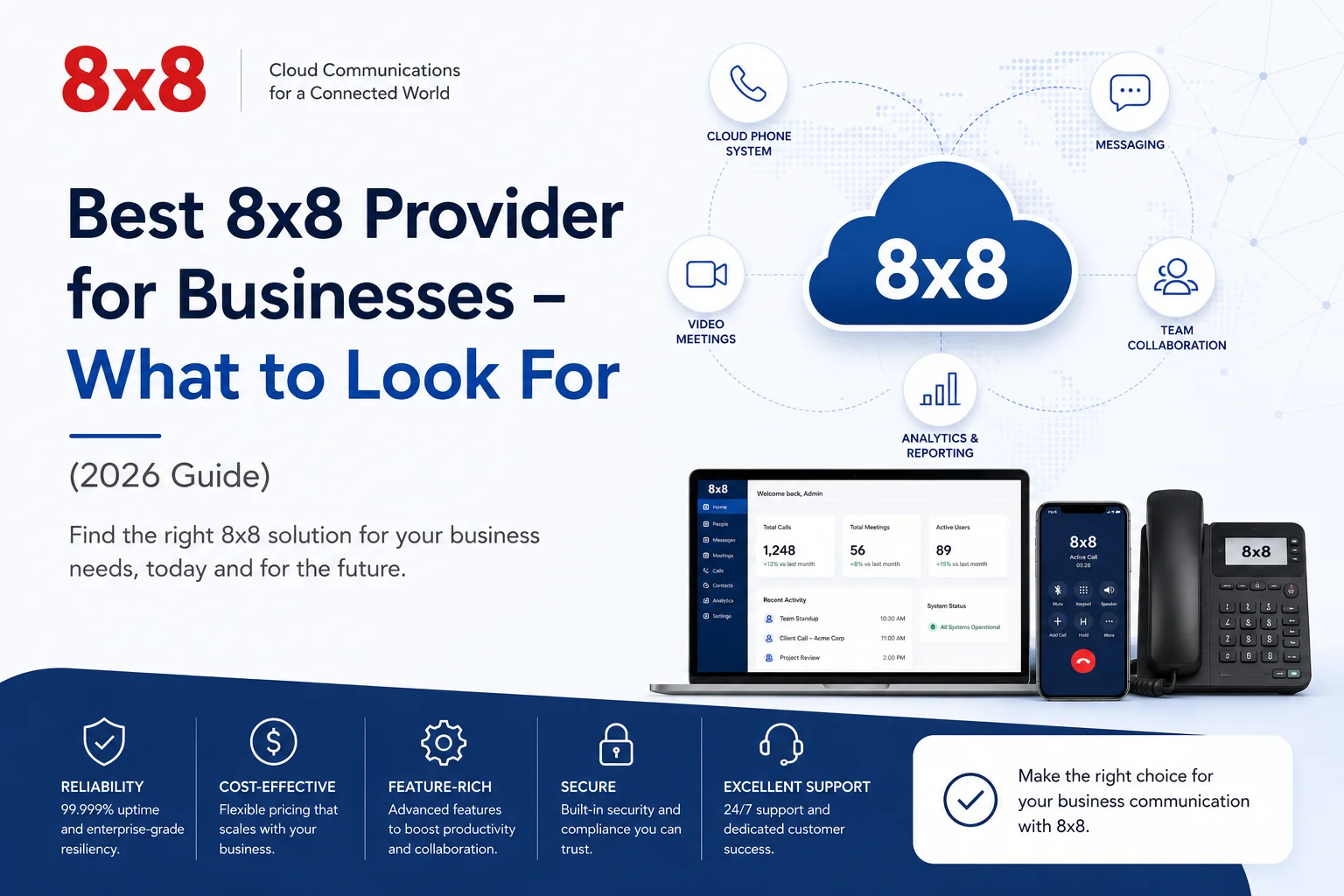
Best 8x8 Provider for Businesses: What to Look For in 2026
Introduction
Most businesses spend a lot of time evaluating 8x8 as a platform — comparing plans, reviewing feature lists, checking pricing. That research matters. But there's a decision that often gets less attention and has an equal impact on outcomes: who you buy from.
8x8 is sold both directly and through a network of authorized resellers and channel partners. The platform is the same either way. What changes is everything around it — how the system gets configured, how quickly problems get resolved, how well the setup actually matches your business workflows, and whether anyone is monitoring performance after the initial deployment.
This guide covers what separates a strong 8x8 provider from a mediocre one, what to specifically look for, and what red flags to avoid — so you make a decision you won't have to revisit in six months.
What Is an 8x8 Reseller or Provider?
An 8x8 reseller is an authorized partner that sells 8x8 licenses and typically wraps additional services around the platform. Depending on the provider, those services might include:
- Initial system design and configuration
- User onboarding and training
- Ongoing technical support
- CRM and software integrations
- Performance monitoring and optimization
- Custom call flow and IVR development
The distinction that matters is this: a reseller that only sells licenses is functionally similar to buying direct, except with a middleman. A provider that treats the relationship as an ongoing partnership delivers something meaningfully different — closer to having a dedicated communications team without the overhead of hiring one.
That gap in service quality is why two businesses using identical 8x8 plans can have entirely different experiences with the system.
Why the Choice of Provider Has Real Business Consequences
Here's what typically happens when businesses buy from a low-touch provider or go direct without adequate support:
The system gets set up quickly, but the configuration is generic. Call routing is functional but not optimized. The auto-attendant was configured by someone who didn't fully understand the business's departmental structure. CRM integration was either skipped or done incorrectly. Nobody is checking whether call analytics are surfacing useful data.
Six months later, the system is technically working — but it's delivering about 60% of the value it could. Employees have worked around its limitations instead of using it well. No one knows the platform well enough to improve it.
This isn't a hypothetical. It's the most common outcome when implementation is treated as a one-time task rather than an ongoing investment.
A capable provider prevents this by treating setup as the beginning of the engagement, not the end of it.
Key Factors That Separate the Best 8x8 Providers
1. Proper Setup and Deployment
The quality of initial configuration has long-term consequences. A provider that cuts corners here — using generic templates instead of designing call flows for your actual team structure, skipping network readiness assessments, or rushing through user setup — creates problems you'll be untangling for months.
What a strong provider does at deployment:
- Audits your network for VoIP readiness before any configuration begins
- Designs call routing based on how your business actually operates, not a generic template
- Configures auto-attendant menus that match your customer journey
- Integrates with your CRM and verifies the integration works correctly
- Sets up analytics and reporting dashboards so there's visibility from day one
- Runs a full end-to-end test before going live
The difference between a generic deployment and a thoughtful one isn't always visible on day one. It shows up over the following months in call quality, feature adoption, and team efficiency.
2. Customization for Your Specific Workflow
No two businesses route calls the same way. A legal firm has different communication needs than an e-commerce brand handling customer returns, which is different again from a SaaS company running a multi-tier support operation.
A provider that offers only standard configurations is essentially offering you a default setup and leaving the rest for you to figure out. The best providers start by understanding your business — how calls come in, who handles them, what the escalation path looks like, which tools your team already uses — and build the 8x8 configuration around those realities.
This includes:
- Custom IVR menu structures that match your actual departments and services
- Ring group and queue configurations based on your staffing model
- Business hours routing that accounts for different schedules across locations or teams
- Voicemail workflows that align with your response time standards
These aren't complex customizations — but they require someone to ask the right questions before touching the Admin Console.
3. Ongoing Support That's Actually Accessible
Support quality is where the difference between providers becomes most visible, and it's where many resellers fall short.
The reality is that issues will come up. A call routing rule breaks after a configuration change. A CRM integration stops logging calls correctly. A new employee's extension isn't receiving calls as expected. How quickly and effectively those issues get resolved directly affects your team's productivity and your customers' experience.
What to look for:
- Defined response time commitments — not just "we'll get back to you"
- A dedicated point of contact, not a generic support queue
- Support availability that matches your business hours (and ideally extends beyond them)
- Proactive communication when 8x8 pushes updates that might affect your configuration
What to be skeptical of:
- Providers whose support is limited to directing you to 8x8's own helpdesk
- Slow response times on initial inquiries (this rarely improves after you're a customer)
- No clear escalation path for urgent issues
Ask any prospective provider directly: what is your average response time for support tickets, and who is my point of contact after the sale?
4. Transparent Pricing with No Hidden Costs
8x8's licensing fees are straightforward. The complications in provider pricing usually come from add-on services, setup fees, minimum contract terms, or support tiers that aren't clearly disclosed upfront.
A trustworthy provider will give you a clear breakdown of:
- Per-user licensing costs
- Any one-time setup or onboarding fees
- Ongoing managed service or support fees, if applicable
- Contract length and cancellation terms
- What's included in the base package versus what costs extra
Cheaper isn't always worse — but price-only decisions tend to correlate with support-light providers. The question worth asking is: what does a support issue or configuration change cost in terms of time and productivity if the provider isn't available to help?
5. Relevant Experience with Similar Businesses
There's a meaningful difference between a provider that has deployed 8x8 for retail businesses and one that primarily works with professional services firms or healthcare organizations. The communication workflows, compliance considerations, and feature priorities are different across industries.
When evaluating providers, ask:
- What types of businesses have you deployed 8x8 for?
- Have you worked with companies at our scale?
- Can you share a case study or reference from a similar organization?
Experience also matters at the technical level. A provider with deep 8x8 knowledge will configure things correctly the first time and identify optimization opportunities you wouldn't find on your own. A provider who learned the platform recently will take longer and may miss things.
6. Performance Monitoring After Go-Live
The best providers don't treat deployment as the finish line. Once your system is live, there's ongoing value in monitoring how it's performing.
This means regularly reviewing:
- Call abandonment rates and queue wait times
- Missed call volumes and after-hours traffic
- Agent response times and performance metrics
- Call quality data (jitter, packet loss, latency)
- Whether call routing is distributing load efficiently
Most businesses don't look at this data regularly because they don't have a process for it. A provider that builds this into the ongoing relationship catches problems early and identifies improvements that compound over time.
Red Flags Worth Taking Seriously
The conversation is mostly about price. Providers who lead with discounts and skip questions about your business needs are signaling their priorities. Price matters, but it shouldn't be the entire conversation.
No questions about your current setup. A good provider needs to understand your existing tools, workflows, and team structure before recommending a configuration. If they're ready to sell without asking, they're not planning to customize.
Support is "you contact 8x8 directly." Some resellers add little beyond the license sale. If their support model routes you back to 8x8's standard helpdesk for everything, you're not getting partner value.
Vague onboarding timeline. If a provider can't clearly explain what happens between signing up and going live, the deployment process is probably not well-structured.
No references or case studies. Established providers have deployments they're proud of and clients willing to speak to their experience. If neither exists, that's information.
Buying direct works well if you have an internal IT team comfortable with VoIP configuration and ongoing administration. For most small and mid-sized businesses without that resource, working with a capable reseller reduces setup time, prevents configuration mistakes, and gives you somewhere to turn when issues arise.
Who Benefits Most from Working with an 8x8 Provider
A managed provider relationship tends to deliver the most value for:
- Growing businesses where communication infrastructure needs to scale alongside headcount
- Customer-facing teams running sales or support operations where call quality and routing directly affect revenue
- Multi-location or remote-first organizations with complex routing requirements across time zones or offices
- Businesses without internal IT who need someone to own the technical configuration and ongoing administration
- Organizations migrating from legacy systems where number porting, integration with existing tools, and staff training need to be carefully managed