
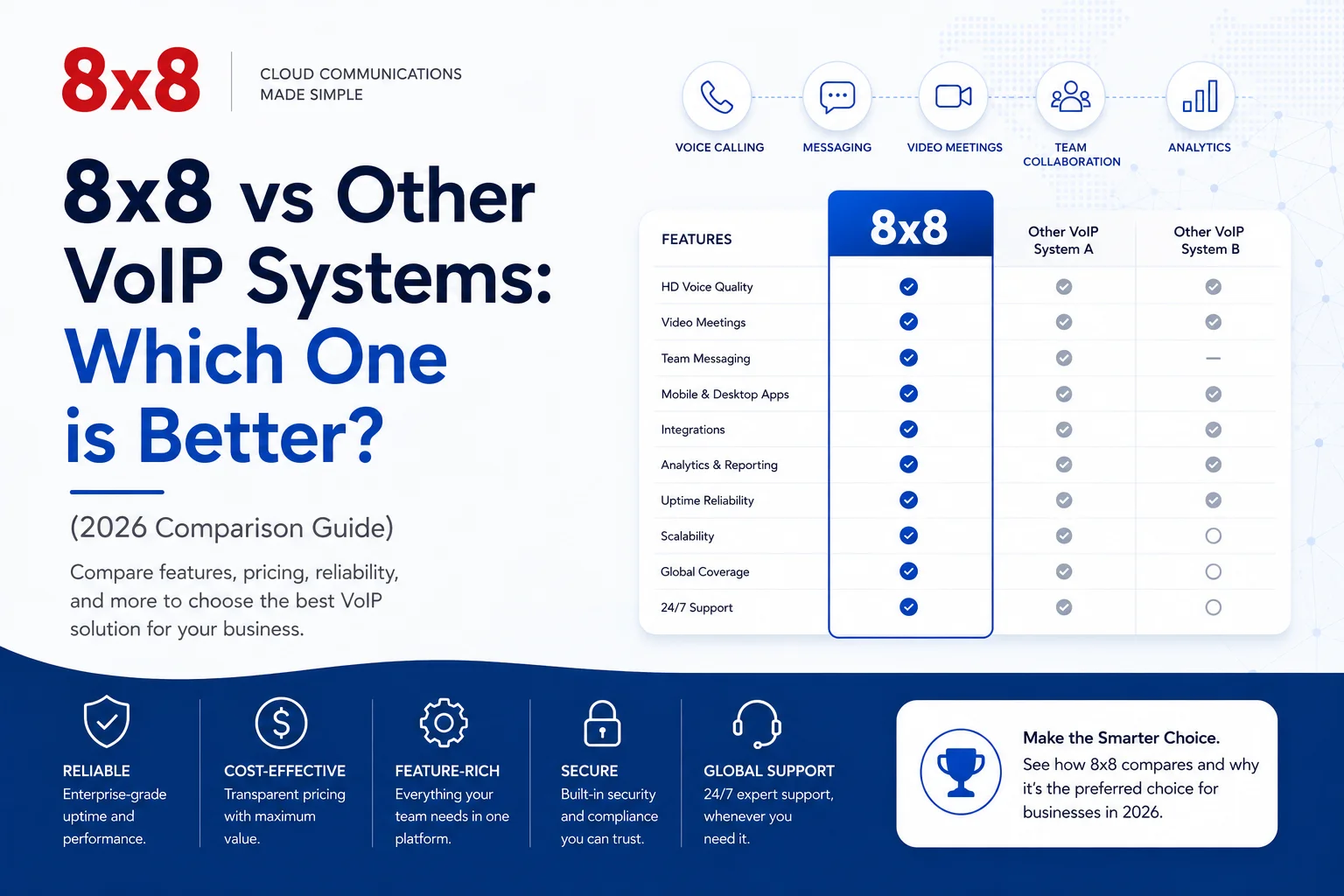
8x8 vs Other VoIP Systems: Which One Is Right for Your Business? (2026 Comparison)
Introduction
There's no shortage of VoIP platforms competing for your business. RingCentral has been the market leader for years. Zoom Phone leveraged its pandemic-era brand recognition to build a solid telephony product. Vonage has held ground on pricing and flexibility. And 8x8 has quietly built one of the most capable all-in-one communication stacks in the market.
The problem with most VoIP comparisons is that they treat feature lists as the deciding factor. In practice, the right platform depends on your team size, your customer communication volume, how technically complex your workflows are, and whether you need a basic business phone line or a full communications infrastructure that scales into contact center territory.
This guide gives you an honest, side-by-side look at 8x8 versus RingCentral, Vonage, and Zoom Phone — where each platform genuinely wins, where it falls short, and which type of business is best served by each.
The Four Platforms at a Glance
Before going deep on comparisons, here's where each platform positions itself in the market:
8x8 — An enterprise-grade unified communications platform that combines UCaaS (business communications), CCaaS (contact center), and CPaaS (developer APIs) in a single system. It's built for organizations that want one platform to handle everything, and it scales from small teams up to large enterprise contact center operations.
RingCentral — The most widely deployed cloud communications platform globally. Known for reliability, a mature ecosystem of integrations, and a well-documented admin experience. It's the safe, proven choice that rarely surprises — positively or negatively.
Vonage — A flexible platform with competitive entry-level pricing and strong API capabilities through Vonage Communications APIs (formerly Nexmo). A good fit for businesses that want affordable VoIP with developer flexibility.
Zoom Phone — Zoom's cloud telephony product, built on the infrastructure that made Zoom Video ubiquitous. It's clean, fast to set up, and works well for organizations already embedded in the Zoom ecosystem. The trade-off is depth — it's strong on simplicity and weaker on advanced call management.
Where 8x8 Has a Genuine Advantage
Unified UCaaS + CCaaS in One Platform
This is 8x8's most meaningful structural advantage over its competitors. Most VoIP platforms are built primarily as business communication tools (UCaaS) with contact center capabilities bolted on as a separate product, a premium add-on, or a third-party integration.
8x8 built contact center functionality natively into the same platform. For businesses running any kind of customer support, sales, or service operation by phone, this matters a lot. You're not managing two separate systems, two vendor relationships, or two billing arrangements. Call routing, agent management, queue analytics, and customer interaction history all live in the same environment.
RingCentral and Vonage both offer contact center solutions — but they're separate products, priced separately, and managed separately. For businesses that need both, 8x8's unified approach is meaningfully simpler and often more cost-effective at scale.
International Calling Coverage
If your business makes regular calls outside your home country, 8x8 has a structural advantage that compounds significantly over time.
The X2 plan includes unlimited calling to 14 countries. The X4 plan extends that to 48 countries. For businesses with overseas offices, international clients, or remote teams spread across multiple countries, this dramatically reduces international calling costs compared to competitors who charge per-minute rates for most international destinations.
RingCentral offers international calling but at per-minute rates or through add-on packages for most markets. Zoom Phone's international coverage is more limited at base plan levels. For purely domestic businesses, this distinction doesn't matter. For anyone with meaningful international call volume, it's a real cost difference.
Analytics and Performance Visibility
8x8's reporting capabilities sit meaningfully ahead of Zoom Phone and Vonage at comparable price points. The analytics dashboard provides call quality metrics, queue performance data, agent productivity reporting, and customer interaction history that gives managers genuine operational visibility.
At higher-tier plans, 8x8 adds AI-powered speech analytics — transcription, sentiment analysis, and conversation intelligence that helps quality management teams review interactions at scale without listening to every recording manually.
Zoom Phone offers basic call reporting. Vonage's analytics at entry and mid-tier plans are functional but not particularly deep. RingCentral's analytics are solid and competitive with 8x8, particularly on higher-tier plans where both platforms offer comparable reporting depth.
Long-Term Scalability Into Enterprise Territory
8x8's platform architecture was built to scale. The same system that handles a 10-person team can accommodate a 500-seat contact center without migrating to a different product. Features, integrations, and routing complexity can grow with the business rather than requiring a platform change at some growth threshold.
This matters most for businesses that expect significant growth or that are building toward a formal contact center operation. Starting on a platform that can handle where you're going — without a disruptive migration later — has real value even if you're not using those capabilities today.
Where Competitors Have the Edge
Zoom Phone: Simplicity and Speed of Deployment
If your primary criteria are fast setup and a clean user experience, Zoom Phone is hard to beat. If your team is already using Zoom for video meetings, adding Zoom Phone is nearly frictionless — same login, same interface, minimal learning curve.
For small teams with straightforward communication needs — calls, basic voicemail, some team messaging — Zoom Phone delivers a good experience at a competitive price without the configuration overhead that 8x8's more capable system sometimes requires.
The trade-off is ceiling. When your needs grow beyond basic telephony, Zoom Phone's depth doesn't scale as well. Contact center features are limited. Analytics are basic. International calling coverage is narrower.
Vonage: Entry-Level Pricing and Developer Flexibility
Vonage competes effectively on price at the entry level, making it attractive for cost-sensitive small businesses. For businesses with developers who want to build custom communication workflows through APIs, Vonage Communications APIs (the former Nexmo product) is one of the more capable developer platforms in the market.
The limitation is that Vonage's base VoIP product for business users doesn't offer the same analytics depth or native contact center functionality as 8x8. It works well for businesses with simpler communication needs, particularly those that want to customize through developer tools.
RingCentral: Reliability and Ecosystem Maturity
RingCentral's strongest argument is track record. It's the most widely deployed business VoIP platform in the world, which means an extremely mature integration ecosystem, well-documented admin processes, and a large community of IT professionals who know how to manage it.
For enterprises with strict uptime requirements and established IT teams, RingCentral's reliability reputation carries weight. It's the lower-risk choice for organizations where "it just works" matters more than being on the cutting edge of feature development.
The gap compared to 8x8 shows up most in international calling costs and native contact center functionality, where RingCentral requires add-ons that 8x8 includes in its core platform.
Which Platform Fits Which Type of Business
Choose 8x8 if:
- Your business operates internationally and makes regular overseas calls
- You're running or building toward a customer support or sales contact center operation
- You want one platform for UCaaS and CCaaS rather than managing two systems
- Analytics and performance visibility are important for managing your team
- You're planning significant growth and want a platform that can scale with you
Choose RingCentral if:
- You want the most proven, widely-deployed platform with an established ecosystem
- Your IT team is already familiar with RingCentral from previous roles
- Uptime reliability and enterprise-grade SLAs are the primary concern
- You don't need extensive international calling or native contact center features
Choose Vonage if:
- Entry-level pricing is the primary driver and your communication needs are relatively simple
- You have developers who want to build custom workflows through communication APIs
- Your team size is small and growth plans are modest near-term
Choose Zoom Phone if:
- Your team is already deeply embedded in Zoom for video meetings and you want a unified experience
- Setup speed and ease of use matter more than feature depth
- Your telephony needs are basic — standard calling, voicemail, simple routing
- Budget is a primary constraint for a small team
Honest Assessment: Where 8x8 Could Improve
Pricing clarity. 8x8's feature-to-plan mapping isn't always immediately obvious, and the range from X2 to X8 can be confusing when you're trying to determine exactly which plan includes which features. Competitors like Zoom Phone present simpler, more transparent pricing structures.
Onboarding complexity. The flip side of a more capable platform is a steeper initial setup. 8x8 rewards businesses that invest time in proper configuration, but it's less forgiving for teams that want to be up and running in an hour without any technical background. Zoom Phone wins on first-day simplicity.
Overkill for minimal use cases. If you have a three-person team making occasional calls, 8x8's full feature set isn't adding value proportional to its cost. Simpler platforms serve genuinely simple needs better.